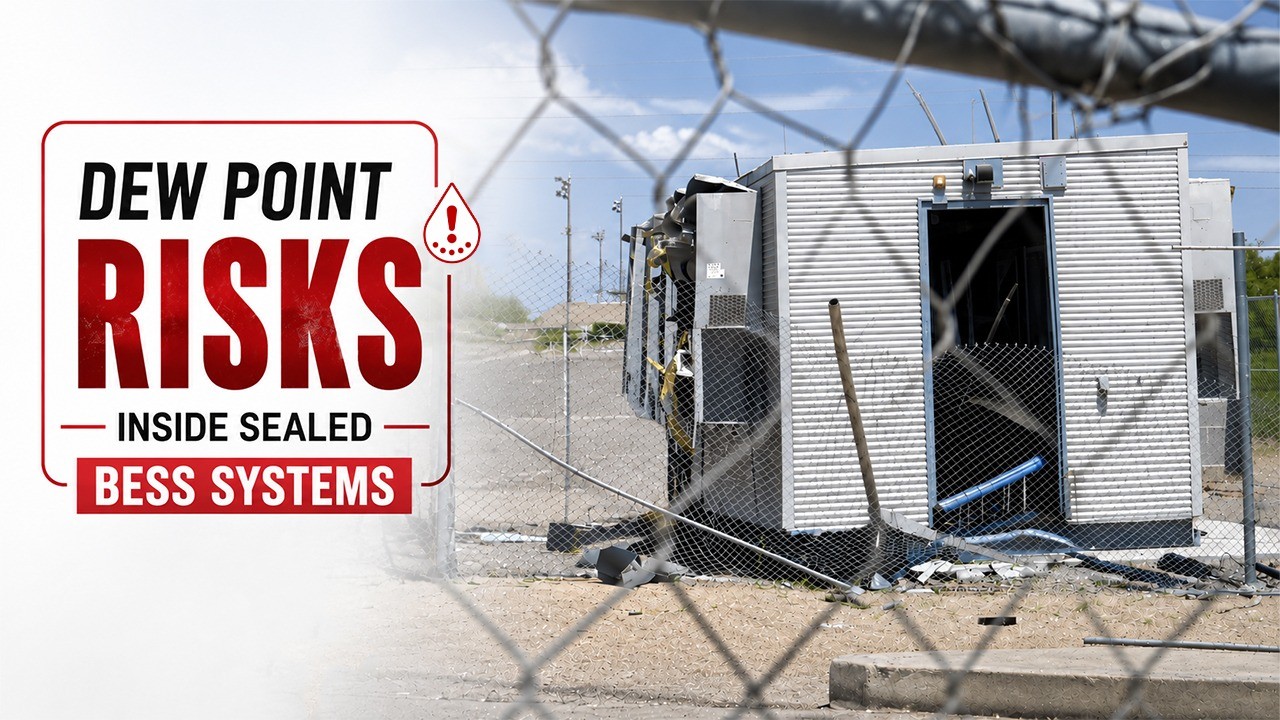
A Battery Energy Storage System (BESS) enclosure carrying an IP65, IP66, or even IP68 ingress rating is often marketed as “sealed” and therefore moisture safe. Field data across outdoor cabinets, telecom shelters, and BESS containers shows the opposite: the most tightly sealed enclosures frequently suffer the most severe internal moisture damage, because sealing prevents rain and dust ingress but does nothing to stop condensation forming from the air already trapped inside. Understanding dew point — not relative humidity — as the governing variable is the foundation of any credible condensation-risk strategy for BESS design, deployment, and O&M in humid, thermally cyclic climates such as India’s.

What Dew Point Actually Measures
Dew point is the temperature to which air must be cooled, at constant pressure, before it becomes saturated and begins depositing liquid water. Unlike relative humidity, which is a ratio that changes automatically with temperature, dew point is an absolute measure of how much water vapor the air actually holds. The controlling physical rule is simple and unforgiving: whenever a surface temperature falls to or below the dew point of the air touching it, water condenses on that surface, regardless of how well-sealed the enclosure is. This means two enclosures reporting identical relative humidity can carry very different condensation risk if their internal surface temperatures differ.

Why “Sealed” Enclosures Still Get Wet
A closed BESS enclosure is not a closed thermodynamic system. As internal air heats during charge/discharge cycles and cools overnight, it expands and contracts, forcing air exchange with the outside through gaskets, cable glands, and pressure-equalization vents. Quantitatively, a 20 K daily temperature swing exchanges roughly 7% of an enclosure’s free air volume per cycle — accumulating to on the order of 25 full enclosure volumes of outdoor air drawn in and expelled over a single year through leakage paths alone. Each intake of outdoor air carries ambient moisture; each subsequent cooling event deposits part of that moisture as liquid on the coldest internal surface, while only vapor escapes on the next warming cycle. The result is a ratchet effect: sealing slows moisture exchange but does not reverse it, so trapped water accumulates cycle after cycle even in cabinets that pass IP66/IP68 ingress testing.

A second failure mode occurs at the moment of factory or site sealing itself. If an enclosure is closed on a warm, humid day, the dew points of the air trapped inside is effectively “baked in” at that value and does not fall just because the enclosure later cools — cooling only brings internal surfaces closer to that fixed dew point, triggering condensation once the threshold is crossed. This is why moisture control during assembly and commissioning (dry-room conditions, drying the internal air before final sealing) is as important as long-term climate control.
The Condensation Sequence Inside a BESS
The typical failure chain proceeds in four steps: warm air inside the cabinet absorbs moisture during the day; external temperature drops rapidly at night, during storms, or with rapid load changes; internal air cools and reaches its dew point; and water condenses on the coldest available metal surfaces — cabinet walls, busbars, cold plates, connectors, and BMS/PCB boards. Coldest-surface locations vary by design but commonly include shaded or wind-exposed exterior walls, the container roof and upper corners, cooling-circuit components, and any point behind insulation gaps or thermal bridges. Condensation risk is therefore not tied to a specific operating state — charging, discharging, or standby can each be the highest-risk period depending on which surface cools fastest relative to the internal air’s dew point.

India-Specific Risk Profile
India’s climate compounds this physics problem in two distinct seasonal ways: summer ambient temperatures frequently exceed 45°C, driving high internal heat loads and large diurnal swings, while monsoon-season humidity sharply raises the moisture content — and therefore the dew point — of both outdoor and infiltrating air. Industry commentary on Indian BESS deployments highlights that most installations still rely only on ambient temperature, surface temperature, and basic humidity sensors, leaving dew point itself unmonitored — a critical blind spot given that condensation on battery surfaces can trigger short circuits, corrosion, and accelerated degradation. Pairing surface-temperature sensors on battery racks with dedicated dew point sensors inside the container and near air intakes is increasingly recommended as the baseline instrumentation needed to predict — rather than react to — condensation events.

Failure Mechanisms Triggered by Condensation

Early symptoms are often subtle rather than catastrophic: nuisance protection trips, unstable current readings, and slow voltage-sensing drift can appear well before a visible short circuit, meaning a pack can look physically intact while creeping corrosion is already altering safety-critical creepage distances on high-voltage modules.
Diagnosing Condensation in the Field
Reliable diagnosis requires two synchronized time-series: internal dew point (computed from co-located temperature and humidity sensors) and the temperature of the coldest suspected surface. Condensation is physically confirmed wherever the surface-temperature trace touches or falls below the dew-point trace; the duration and frequency of these crossings quantifies the actual risk exposure, not a single snapshot reading. Useful corroborating evidence includes water staining, corrosion at terminations, or insulation-monitoring alarms that cluster in the early morning hours, when overnight radiative cooling is most likely to drive surfaces below dew point. Logging should use a common clock across charge/discharge status, battery and PCS power, internal and outdoor temperature/RH, surface temperatures, HVAC/dehumidifier run status, and door/vent events, sampled frequently enough (minutes, not hourly averages) to catch the transition rather than only the daily mean.

Dew Point Reference Values
The relationship between temperature, relative humidity, and dew point is non-linear, which is why RH specifications alone are insufficient for enclosure design. Representative values illustrate the scale of moisture involved:

Dew point can be computed using the Magnus relationship: γ = ln(RH/100) + (17.62 × T)/(243.12 + T), then Td = (243.12 × γ)/(17.62 − γ), valid roughly between −45°C and +60°C. As a worked example, air at 35°C and 50% RH yields a dew point of 23.0°C — meaning any internal surface below 23.0°C will condense moisture under those conditions.
Empirical Failure Analysis

Forensic analysis of major utility-scale BESS safety events confirms environmental moisture and condensation as primary root causes:
- McMicken, Arizona Incident (2019): Investigation reports by DNV GL highlighted that inadequate environmental control significantly contributed to the initial system fault. Environmental sensors were improperly placed to record localized microclimatic extremes, masking steady internal dew point rises. Internal relative humidity exceeded 80%, resulting in condensation on high-voltage electronics that triggered an internal arc, cascading cell thermal runaway, and a subsequent flammable off-gas explosion.

- South Korean ESS Fire Wave (2017–2019): An investigation into over 20 stationary storage fires revealed a systemic vulnerability to environmental cycling. Systems installed in humid, mountainous regions experienced extreme outdoor diurnal temperature swings. Inadequately sealed enclosures combined with dust accumulation led to widespread condensation on busbars, causing terminal arcing, insulation breakdown, and catastrophic fires.

- Victorian Big Battery, Australia (2021): During commissioning, a leak in a liquid cooling loop on a Megapack unit allowed liquid coolant to bridge electrical modules, initiating electrical arcing. The resulting thermal energy triggered thermal runaway that consumed two complete containerized units.

- Warwick, New York Incident (2023): An official root-cause evaluation confirmed that rainwater seepage combined with internal condensation caused electrical shorting on battery racks, escalating into an industrial container fire.

Design and Mitigation Strategies
Effective condensation control in sealed BESS enclosures rests on a layered strategy rather than a single fix:
- Control against dew point, not RH. The design target should keep internal dew point safely below the coldest expected surface temperature, with margin for sensor tolerance (typically 1–2 K of dew-point uncertainty from capacitive RH sensors), spatial variation, and control lag.
- Raise the coldest surface temperature. Insulating exterior panels, shading from night-sky radiation, or relocating equipment away from wind-exposed faces can move the coldest surface above the dew point without adding active equipment.
- Reduce moisture intake. Auditing and maintaining continuous-pour gaskets, using IP68-rated cable glands, and eliminating open knockouts reduces (though does not eliminate) the rate of moisture exchange through leakage paths.
- Actively remove moisture. An enclosure-scale dehumidifier lowers internal dew point directly and is the only measure that reduces condensation risk across all internal surfaces simultaneously; it must be sized to the enclosure’s free air volume, moisture load, and full temperature range.

- Manage necessary ventilation air. Where ventilation is required for other reasons (e.g., off-gas dilution in lithium-ion installations), conditioning that incoming air stream addresses the moisture it introduces.
- Provide drainage as a backstop. One-way drain plugs at the enclosure base allow any accumulated liquid to escape by gravity even when active systems are in place.
- Integrate dew-point prediction into the BMS. Advanced BMS logic that tracks humidity and thermal trends can preemptively trigger HVAC or dehumidification before moisture actually forms, rather than reacting to it after the fact.
- Protect electronics at the component level. Conformal coatings (acrylic, silicone, urethane, or Parylene, typically 1–3 mil / 25–75 µm thick) provide a semi-permeable dielectric barrier on BMS and PCB boards, though they are explicitly not designed for continuous immersion or constantly saturated air above roughly 80% RH — at that exposure level, potting, encapsulation, or fully sealed housings become necessary.
Cooling System and Moisture Control Are Separate Jobs
A common design error is assuming that a thermal management system sized for battery heat load automatically manages enclosure humidity. Battery thermal management protects cell and module temperature; enclosure moisture control protects the surrounding air and surfaces — busbars, controls, and auxiliary equipment — and the two systems interact but perform different functions. Advanced liquid-cooling architectures that incorporate dew-point prediction logic can keep cooling-plate temperatures optimized for cell longevity while avoiding thresholds that trigger internal condensation, but a cooling system alone, without dedicated dew-point monitoring, does not guarantee a safe humidity margin throughout the enclosure.
Standards Context
IEC 62933-4-3 specifically addresses environmental effects — including humidity, alongside temperature, vibration, and natural disasters — on BESS, describing causes, chains of events, and mitigation measures for the full system including power and communication connections. IEC 62933-5-2 covers broader safety requirements across the BESS lifecycle from design through end of service, while related standards define testing methods for evaluating environmental resilience. These frameworks reinforce that humidity and condensation are recognized system-level risks requiring documented design measures, not incidental concerns to be handled ad hoc at the enclosure level.

Practical Takeaway for Deployment Planning
Specifying an IP rating alone is not a condensation-control strategy; it addresses external ingress, not internally generated moisture from trapped or infiltrating humid air. A defensible design brief should document the enclosure’s free air volume, indoor/outdoor site design conditions across the full annual temperature range (including monsoon peaks and winter minimums for the Indian context), internal heat sources, the ventilation arrangement, the coldest relevant surface temperature (measured, not assumed), and the specific dew-point margin the control system is meant to maintain. Given that sensor and dehumidification costs are minor compared to the cost of a thermal-runaway event or premature BMS failure from corrosion, dew point instrumentation is best treated as a standard line item in BESS specifications for humid, high-temperature-swing markets rather than an optional upgrade.
No responses yet