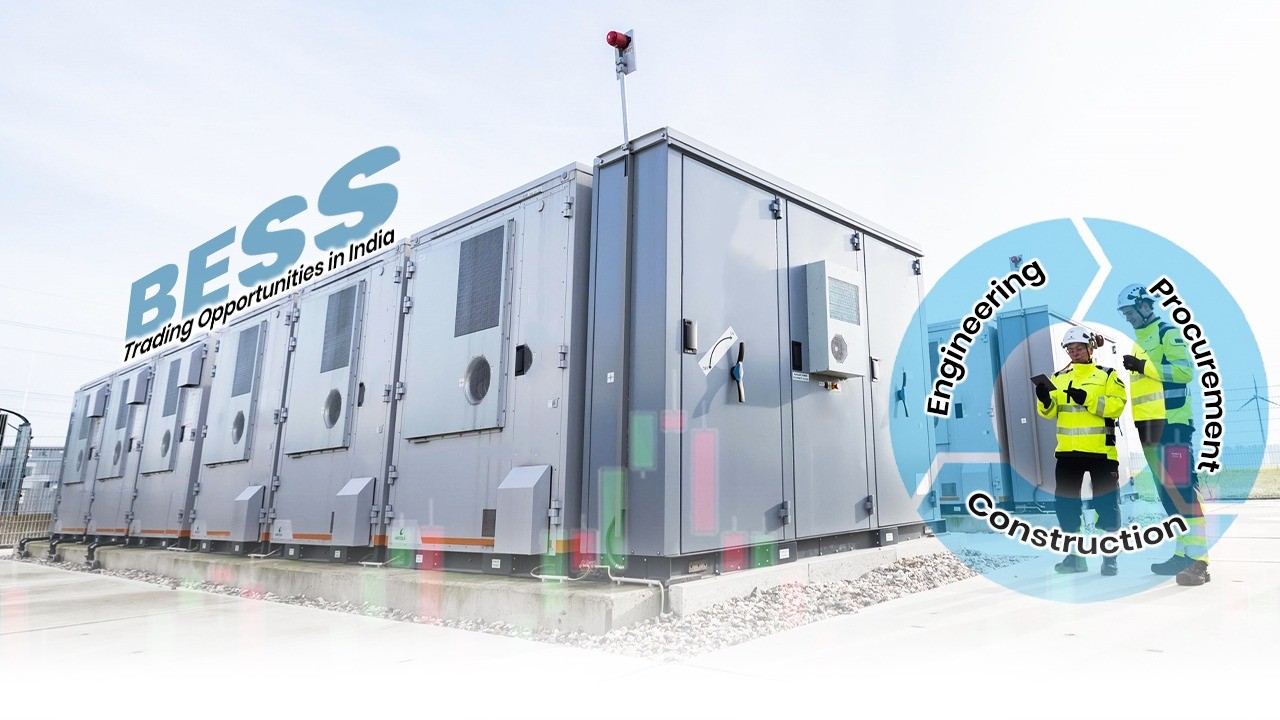
India’s Battery Energy Storage System (BESS) sector has crossed the threshold from pilot demonstration to mainstream grid and commercial infrastructure. Installed capacity leapt roughly eleven-fold, from 0.78 GWh in December 2025 to 8.7 GWh in the first half of 2026, and the country is on track to exceed 10 GWh of installed BESS by year-end. Tender-discovered tariffs for 2-hour standalone storage collapsed from ₹10.83 lakh/MW/month in 2022 to a record ₹1.48 lakh/MW/month by December 2025, an 86% fall in under three years. Against this backdrop, two distinct but complementary business opportunities have opened for operators, investors, and technical consultants: EPC (Engineering, Procurement, Construction) execution of BESS projects, and merchant trading of stored electricity on power exchanges.

Why 2026 Is the Inflection Point
India’s National Electricity Plan projects a base-case BESS requirement of 8.68 GW/34.72 GWh in 2026-27, scaling to 47.24 GW/236.22 GWh by 2031-32, with an associated investment requirement of about ₹3.49 lakh crore. Longer-range CEA and industry projections put cumulative storage need at 888 GWh by 2035-36 and as much as 1,840 GWh by 2047. The overall India BESS market is valued at $2.05 billion in 2026 and is forecast to reach $8.59 billion by 2031, growing at a 33.2% CAGR. In H1 2026 alone, 47 GWh of new energy storage tenders were floated, lifting the total pipeline to 260 GWh, of which 70% of newly commissioned capacity came from merchant (non-PPA) BESS installations — a clear signal that trading-led business models are gaining traction alongside contracted capacity.
Policy and Regulatory Tailwinds
A dense stack of central and state incentives underwrites the current opportunity. Under the Viability Gap Funding (VGF) scheme, Tranche I offered up to ₹27 lakh/MWh or 30% of capital cost (whichever was lower), while Tranche II, effective July 2025, reset the ceiling to ₹18 lakh/MWh as competitive bidding and falling cell prices compressed tariffs. A second VGF tranche of ₹5,400 crore is now supporting 30 GWh of standalone BESS, with a 20% domestic value-addition mandate attached.

State-level action is compounding these central measures: Rajasthan’s Green Open Access mandates 5% BESS attachment with headroom up to 200% of contract demand, Maharashtra will require rooftop RE above 100 kW to pair with minimum storage from April 2026, and West Bengal, Telangana, Gujarat, and Uttar Pradesh have all floated large state BESS tenders in 2026.

The EPC Opportunity
EPC execution sits at the center of the buildout because every awarded tender — whether won by BHEL, L&T, Adani, or a specialist storage developer — ultimately requires civil works, electrical balance-of-plant, BMS commissioning support, and ongoing operations and maintenance, much of which is subcontracted to regional partners. A practical entry strategy documented in industry proposals involves importing containerized BESS from China for resale to Indian C&I customers and tender winners, while parallelly partnering with the 5-6 Indian integrators that already run cell-to-pack, rack, and container assembly lines to avoid high customs duties on finished systems.
Smaller-capacity joint venture participation (for example, 50 MW/100 MWh) under long-term Battery Energy Storage Purchase Agreements (15 years) using a Build-Own-Operate structure is highlighted as an accessible entry point for new entrants without utility-scale balance sheets. Recurring O&M revenue is also material: a single 500 kWh commercial BESS O&M contract can generate ₹3-5 lakh annually, and scaling across 20 such installations produce ₹60-100 lakh in yearly recurring revenue from projects already executed.

Manufacturing Base Supporting EPC
Domestic capacity is scaling rapidly, reducing EPCs’ dependence on pure imports over time.

Despite this buildout, India’s Li-ion cell manufacturing capacity remains around 2 GWh against announced targets of ~110 GWh by 2030, and current Indian battery costs (USD 70-80/kWh) still trail Chinese FOB pricing (~USD 55/kWh), sustaining the near-term case for import-linked EPC models even as PLI-backed localization accelerates.
The Trading Opportunity
Merchant BESS trading — buying power cheap during solar-surplus hours and selling it at evening peak on the Indian Energy Exchange (IEX) — has become commercially viable as intraday price spreads have widened. In April 2026, Real-Time Market prices fell to near-zero while Day-Ahead evening prices touched ₹10/unit, one of the widest spreads India’s power market has recorded. For a 100 MW/400 MWh battery, industry calculations put gross arbitrage revenue at ₹24-28 lakh per day, or roughly ₹72-84 crore annually over 300 operating days, translating to a project IRR of 15.5-18% from arbitrage alone. Layering ancillary services such as Secondary and Tertiary Reserve Ancillary Services (SRAS/TRAS), where batteries are paid for grid balancing and frequency support, can lift returns to 22-24% IRR.

Regulatory support for this model has firmed up: BESS-supplied electricity is permitted to participate in the High-Price Day-Ahead Market launched in March 2023, letting storage respond to peak price signals similarly to gas-based generation, and pure merchant trading on IEX carries a 10% market-share cap. Recent exchange data underscore the spread economics: a 100 MW/4-hour arbitrage position was generating roughly ₹34.8 lakh per day against a benchmark price point near ₹3,722/MWh. Some state tenders also now permit participation in market services once developers meet their committed contracted energy delivery, effectively allowing a hybrid contracted-plus-merchant revenue stack.

Power Exchange Arbitrage via High-Price Day-Ahead Market (HP-DAM)
To monetize uncontracted storage assets or merchant capacity, the Central Electricity Regulatory Commission (CERC) permitted BESS operators to participate in the High-Price Day-Ahead Market (HP-DAM) segment on Indian power exchanges. HP-DAM utilizes double-sided, closed-auction bidding powered by Mixed-Integer Linear Programming (MILP) engines.
BESS market participants charge their systems during off-peak solar hours when prices on the Day-Ahead Market (DAM) or Green Day-Ahead Market (G-DAM) clear at low rates (e.g., ₹2.00–₹3.50/kWh). They then discharge into HP-DAM during evening peak hours when clearing tariffs approach higher regulatory price caps (historically up to ₹20.00/kWh).

Behind-The-Meter (BTM) Industrial Monetization
Amendments to the Electricity (Rights of Consumers) Rules mandated that commercial and industrial (C&I) facilities transition away from diesel generators for backup power. C&I facility managers deploy behind-the-meter BESS assets to capture three direct financial returns: clipping peak kVA demand spikes to lower fixed DISCOM monthly charges, shifting energy consumption out of expensive Time-of-Day (ToD) tariff windows, and storing surplus rooftop solar power for night-shift manufacturing.
Risks and Bottlenecks
Despite strong tailwinds, structural gaps persist. Only 219 MWh of BESS capacity was operational out of 12.8 GWh auctioned between 2022 and May 2025, reflecting execution delays tied to high financing costs and aggressive underbidding. The sector also faces limited domestic technology readiness in advanced cell chemistries, heavy import dependence, an immature local vendor and testing ecosystem, and shortages of skilled labor and patient capital. Regulatory uncertainty adds near-term complexity: the draft Ministry of Power rules on net metering charges and mandatory storage above 500 kW remain unfinalized, with a targeted effective date of October 1, 2026, meaning EPCs must build contingency into current proposals.

Beyond debt coverage, project financial returns remain sensitive to fiscal and regulatory headwinds:
- Import Duties: Li-ion cells attract a 5% Basic Customs Duty alongside a 28% GST rate structure, creating a significant tax burden for non-vertically integrated EPC contractors.
- Auxiliary Power Drag: Inefficient thermal management designs draw significant parasitic auxiliary power, lowering system round-trip efficiency below contractual thresholds and triggering financial penalties from DISCOMs.
- Regulatory Off-Take Delays: Winning a competitive auction does not guarantee immediate project execution. Multiple State Electricity Regulatory Commissions have delayed tariff adoption for bids that significantly exceed conventional solar generation tariffs, stalling financial closure.
Building a Combined EPC-Trading Model
Industry proposals increasingly frame EPC and trading as complementary rather than separate businesses: an entity that executes EPC contracts also gains privileged access to build merchant or hybrid BESS assets it can subsequently operate and trade. This combined approach captures value across the chain — equipment margin and O&M fees from EPC execution, plus arbitrage and ancillary-service revenue from asset ownership — while VGF, ISTS waivers, and the ESO mandate reduce the effective cost of capital and guarantee a portion of offtake demand. Given that turnkey grid-scale BESS costs around ₹1.5-1.8 crore per MWh installed in 2026 and standalone tariffs of ₹2.5-2.85 lakh/MW/month are achievable even without VGF in the most competitive tenders, the economics favor entrants who can execute EPC delivery quickly while positioning owned assets for the widening arbitrage spreads on IEX.
No Responses