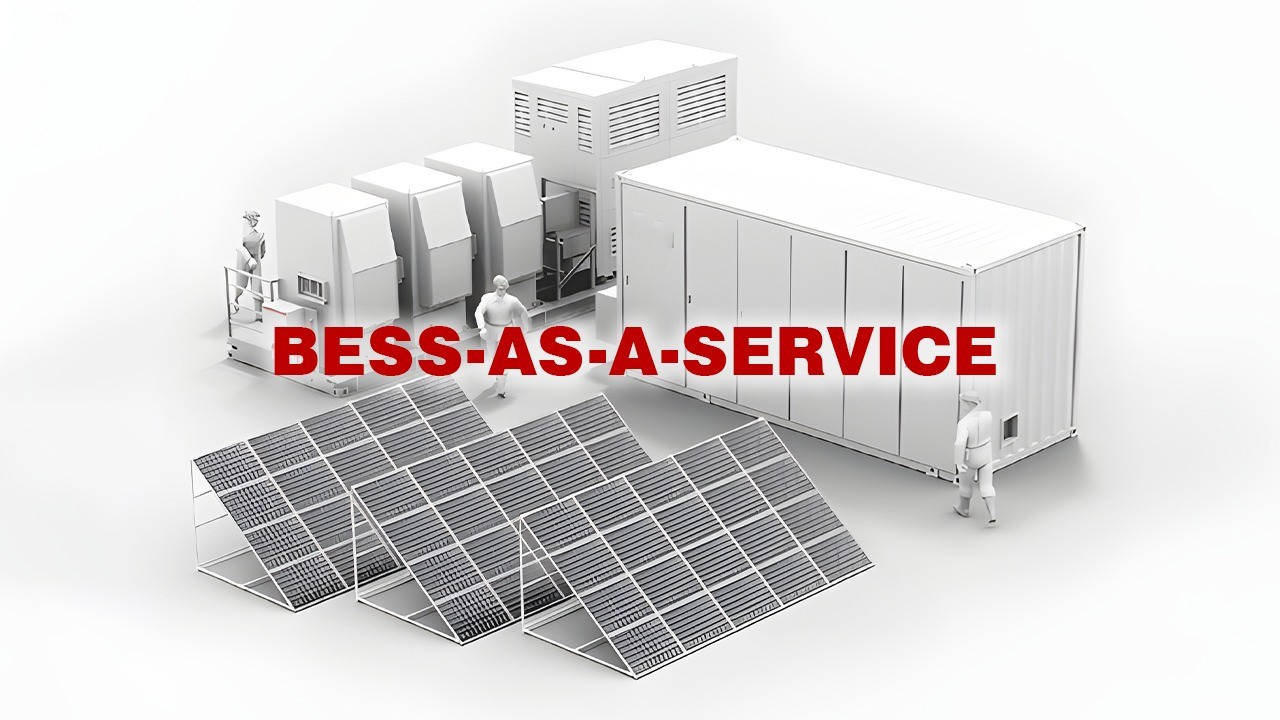
Battery Energy Storage Systems-as-a-Service (BESSaaS) is a rapidly maturing business model that decouples the benefits of energy storage from the burden of asset ownership. By shifting capital expenditure to operational expenditure through subscription-based arrangements, BESSaaS is unlocking battery storage for a far broader range of commercial and industrial customers than traditional ownership models ever could. The model mirrors the broader “as-a-service” transformation seen in software and cloud infrastructure — but applied to physical energy infrastructure at a time of unprecedented grid pressure.

The Energy Storage as a Service market was estimated at USD 5.78 billion in 2024 and is projected to grow to USD 40.37 billion by 2035, at a CAGR of 19.33%. The broader BESS market was estimated at USD 103.80 billion in 2025 and is expected to grow at a CAGR of 26.8% through 2034. These growth trajectories are being shaped in no small part by the emergence of service-based delivery models that lower the commercial and technical barriers to adoption.
What Is BESSaaS?
BESSaaS is a performance-based service contract under which a third-party provider finances, designs, installs, operates, and maintains a battery energy storage system on behalf of a customer. The service provider retains ownership of the physical asset and takes on operational risk, while the customer pays a periodic — typically quarterly — subscription fee rather than bearing the capital cost upfront.
At its core, the value proposition is simple: customers pay for outcomes, not hardware. Instead of asking “Do I want a battery?”, businesses ask “Do I want the benefits a battery can deliver?” The model bundles hardware, software, lifecycle management, performance guarantees, predictive maintenance, and energy market participation support into a single managed service.

Contracts typically span 15 to 20 years and are structured so that day-one financial returns are possible — meaning the savings and revenues generated by the battery can exceed the quarterly service fee from the outset.
BESSaaS Business Model Architectures
The BESSaaS framework encompasses several commercial structures designed to align the risk profiles and capital preferences of providers, finance partners, and end-users. These architectures govern how system costs are bundled, how financial savings are distributed, and how accounting and tax benefits are realized.
From CapEx to OpEx
The defining financial feature of BESSaaS is the elimination of upfront capital expenditure. Under a traditional ownership model, a commercial or industrial site might spend €800,000 or more for a 5-MWh system — with ROI only materialising over years. BESSaaS converts this to an OpEx line item, which not only eases cash flow but allows the charge to be booked as an operating expense rather than a balance sheet liability.

This shift is meaningful for corporate finance teams. The CapEx-to-OpEx transition improves reported free cash flow, avoids asset depreciation headaches, and can facilitate project financing and commercial close in situations where a large capital commitment would have stalled a deal.
Shared Savings Agreements
The shared savings model is a primary commercial structure in the C&I segment. Under this framework, the BESSaaS provider assumes 100% of the CAPEX for equipment acquisition, engineering, permitting, and installation. In return, the provider and the customer share the verified financial savings generated by the system.

These savings are primarily derived from demand charge reduction (peak shaving) and energy tariff arbitrage. The provider manages the continuous dispatch optimization of the battery via automated software platforms, ensuring that the system discharges during the facility’s highest-demand intervals to lower peak kilowatt draw.
Predictable Operating Leases
For enterprises seeking high-cost predictability and full control over financial upside, the operating lease model offers a structured, zero-CAPEX alternative. In this configuration, the BESSaaS provider or associated finance partner purchases, installs, and maintains the behind-the-meter storage asset on the customer’s site.
The customer pays a fixed, predictable periodic lease fee (typically monthly or quarterly) over a standard contract term of five to seven years. This fixed fee covers all hardware, energy management software, remote monitoring, and scheduled preventive maintenance.

From an accounting perspective, operating leases are structured to meet specific off-balance-sheet requirements under global financial standards (such as keeping lease values below key recognition thresholds under IND AS 116 or IFRS 16). This design allows lease payments to be categorized as fully tax-deductible operating expenses.
Consequently, an enterprise’s debt covenants, leverage ratios, and Return on Capital Employed (ROCE) remain unaffected. Because the lease cost is fixed, any financial upside generated by peak shaving, solar self-consumption, or energy arbitrage beyond the lease rate is retained entirely by the customer. At the end of the lease term, the customer can choose to renew at a depreciated rate, upgrade to a modern battery system, purchase the asset at its fair market residual value, or request a complete system removal.
Tolling and Capacity-as-a-Service PPAs
Tolling agreements and Capacity Power Purchase Agreements (PPAs) are highly prevalent in grid-scale and large-scale C&I applications. Under a BESS tolling structure, a project developer funds, builds, owns, and operates the utility-scale battery asset, while an off-taker—typically an electric utility, an independent power producer (IPP), or a large-scale data center—enters into a long-term contract.

The off taker pays a structured capacity fee, resembling a traditional toll, to secure exclusive rights to charge and discharge the battery. The asset owner guarantees a minimum round-trip efficiency, specific power and energy capacity levels, and system availability (often exceeding 98.5%).
The off taker leverages this capacity to mitigate transmission congestion, execute bulk energy arbitrage, manage high-density load profile ramps, or participate in wholesale energy and ancillary services markets. This model is illustrated by the 100 MW/331 MWh Bramley project in Hampshire, UK, which secured a market-first seven-year tolling agreement with Shell Energy Europe, illustrating how long-term tolling structures facilitate debt project financing for large-scale storage assets.

Hybrid Ownership-Service Models
The hybrid BESS model combines elements of asset ownership with outsourced professional management. This structure is favored by larger C&I entities and municipal utilities that possess the low-cost capital required to purchase BESS hardware directly but lack the internal software platforms, real-time market access, and technical expertise to manage the system.
The customer buys the hardware, utilizing available tax incentives, accelerated depreciation, or green bonds to optimize the initial purchase. Simultaneously, they execute a Long-Term Service Agreement (LTSA) with a specialized BESSaaS provider.
The provider assumes responsibility for remote asset monitoring, predictive diagnostic services, performance-guaranteed maintenance, and software-driven dispatch optimization. This split-scope architecture mitigates technical and degradation risks while allowing the asset owner to capture 100% of the long-term asset residual value and project cash flows.

Revenue Model Summary

Key Players and Competitive Landscape
ABB: Pioneer of the BESSaaS Model
ABB launched its formal BESSaaS offering in May 2025, positioning it as “the first in a range of next-generation service models being developed to remove the barriers to clean technology adoption”. The ABB model is technology-agnostic — compatible with any battery chemistry — and covers hardware, software, lifecycle support, deployment, maintenance, and energy trading brokerage, all under a quarterly service fee. ABB manages energy market participation on behalf of the customer, ensuring revenue from selling excess energy flows through without requiring customer expertise.

Brazil: Agribusiness Optimization and Isolated Grid Autonomy
Pioneering energy companies like Matrix Energia and Brasol have established structured ESaaS partnerships to deploy BTM projects without CAPEX limits. Matrix Energia, in collaboration with Huawei, has committed to installing 750 MWh of storage capacity by 2027. This portfolio includes a major municipal project with the city of São Paulo to deploy integrated BESS and high-speed EV chargers at public bus depots, expanding local fleet recharging capacity sixfold without triggering expensive utility grid upgrades.

North America and Europe: VPPs, Congestion Relief, and Policy Support
In the United States, the Federal Energy Regulatory Commission’s (FERC) landmark Order No. 2222 requires regional grid operators (RTOs/ISOs) to remove entry barriers for distributed energy resource (DER) aggregators. This regulation allows distributed, aggregated BESSaaS portfolios to participate in wholesale energy markets alongside utility-scale power plants.
In highly structured markets like CAISO (California) and ERCOT (Texas), pioneers like Stem Inc. deploy their proprietary Athena AI platform to aggregate hundreds of behind-the-meter C&I storage systems. This platform automatically executes real-time peak shaving for end-users while simultaneously bidding aggregated portfolio capacity into the wholesale grid to support frequency stability.

Broader Ecosystem
The BESSaaS value chain involves multiple layers of participants:

McKinsey estimates system integrators will capture 25–30% of the BESS profit pool, reflecting the premium placed on software optimisation and service delivery capability.
India: An Emerging BESSaaS Frontier
India’s BESS market was valued at USD 2.05 billion in 2026 and is forecast to reach USD 8.59 billion by 2031 at a CAGR of 33.20%. Key domestic players include Tata Power Renewable Energy, Reliance New Energy, Adani Energy Solutions, JSW Energy, Exide Energy Solutions, and Amara Raja. India’s Government-backed Viability Gap Funding (VGF) scheme for BESS has accelerated the market, and Institute for Energy Economics and Financial Analysis (IEEFA) data shows hybrid renewable+storage tendered capacity surged to 49% of total sustainable energy tenders in 2024, up from just 12% in 2021. The total BESS opportunity in India’s value chain is estimated at USD 42 billion by 2032.

In India, BESSaaS providers must navigate CERC/POSOCO regulatory frameworks for ancillary services, with value stacking delivering 50–70% of returns from ancillary services on IEX/POSOCO platforms. Frequency regulation pays ₹10–15 lakh/MW-month in availability fees, and BESS sub-second response can generate ₹150–200 crore NPV over 15 years for 100 MW systems.
To illustrate the economic transition from diesel backup to a BESSaaS operating lease, the following table models an industrial plant operating a 500 kVA facility under standard Indian tariff conditions. This model shows a net annual operating savings of over INR 30 Lakhs by shifting from diesel-based generation to a zero-CAPEX lease system:

This regulatory landscape is complemented by standard operating leases provided by companies like PWRNXT – Next Gen Power Systems, which offer zero-CAPEX installations backed by a contractual 98.5% uptime SLA. To eliminate execution risk, PWRNXTs systems are preconfigured with CATL, BYD, or EVE Energy Co.,Ltd. LFP cells and Sungrow or Delta power electronics. These are certified under UL 9540A, IEC 62619, and NFPA 855 and are designed to interface directly with existing diesel generator control panels from OEMs like Cummins India, KIRLOSKAR ELECTRIC COMPANY LTD., and Greaves Power Lanka. These structures are underwritten by leading green capital funds and non-banking financial companies (NBFCs), including the Indian Renewable Energy Development Agency Limited (Ireda), L&T Finance, and the SIDBI Green Fund, allowing C&I sites to deploy advanced storage configurations (ranging from the PX-125 cabinet to the PX-5000 5MWh container) in under ten weeks.

Data Center and Microgrid Deep-Dive
The deployment of BESSaaS is rapidly expanding in two highly specialized sectors that demand extreme reliability and uptime: data centers and isolated microgrids. Both segments benefit from the shift to OPEX-led, software-managed configurations.
Hyperscale and Tier 4 Data Center Integration
Data centers require continuous, high-density power. The global data center energy storage market was valued at USD 4.2 billion in 2024 and is projected to expand to USD 18.3 billion by 2032, representing a CAGR of 20.2%. Within this market, the large-scale and hyperscale segments accounted for 58% of deployment in 2024, driven by the expansion of cloud computing and AI workloads. Tier 4 data centers, which require full physical redundancy and 99.99% uptime, held a 44% market share, with lithium-ion systems representing 63% of installations.

Concurrently, the specialized Battery Energy Storage as a Service for Data Centers market is projected to grow from USD 2.7 billion in 2024 to USD 12.7 billion by 2033, registering a CAGR of 19.4%. Under the BESSaaS model, operators use battery storage to replace traditional diesel backup systems, execute peak shaving during periods of high computing load, and participate in grid-level demand response programs.
This transition is supported by modular, plug-and-play platforms from manufacturers like Cummins and Siemens, which provide preconfigured systems ranging from 211 kWh to 2,280 kWh. These systems allow operators to scale storage capacity as computing demand grows, minimizing upfront capital requirements and transferring technology risk to the service provider.

Battery Storage for Microgrids and Islanded Grids
For remote communities, mining sites, and isolated utility networks, microgrids with integrated BESS provide a reliable alternative to centralized grid infrastructure. The global market for battery energy storage in microgrids was valued at USD 18.6 billion in 2025 and is projected to reach USD 113.5 billion by 2034, representing a CAGR of 20.4%. Deployed microgrid capacity connected to battery storage is expected to exceed 45 GWh on an annual basis.
A primary driver of this market is the declining cost of storage, with the levelized cost of storage (LCOS) for lithium-ion systems in microgrid configurations falling by approximately 40% since 2020. This cost reduction makes solar-plus-storage hybrid systems economically competitive with traditional diesel generation.

Conclusions and Strategic Recommendations
The transition from asset ownership to BESS-as-a-Service is altering the economics of energy storage, enabling commercial and industrial enterprises to utilize flexible storage without upfront capital requirements. By shifting the burdens of execution, operations, and degradation to specialized third-party providers, the model accelerates behind-the-meter storage adoption while creating aggregated grid assets. Based on this analysis of business models, value streams, and regulatory frameworks, the following strategic actions are recommended:
For Commercial and Industrial Procurement Leaders: Organizations should transition from traditional CAPEX-based energy procurement to OPEX-based BESSaaS models, matching lease terms to local tariff profiles. In regions with high demand charges or complex tariff structures (such as Maharashtra, India, or CAISO, USA), procurement teams should evaluate shared savings or fixed operating lease agreements to secure day-one energy savings and hedge against rising utility demand charges.
For Project Developers and BESSaaS Providers: Providers must design flexible, modular, chemistry-agnostic hardware architectures that simplify future capacity augmentation. Additionally, integrating advanced AI-driven software is critical for optimizing value stacking across multiple revenue streams (e.g., peak shaving, energy arbitrage, and ancillary services) to maximize financial returns under performance-guaranteed contracts.
For Grid Operators and Regulatory Policymakers: Regulatory bodies should establish clear, transparent, and stable frameworks that recognize the system-level benefits of fast-responding storage assets. Following the example of FERC Order No. 2222, policymakers should remove market access barriers for aggregated distributed energy resources, enabling virtual power plants to support grid stability and lower decarbonization costs.
______________________________________________________________________________
No Responses