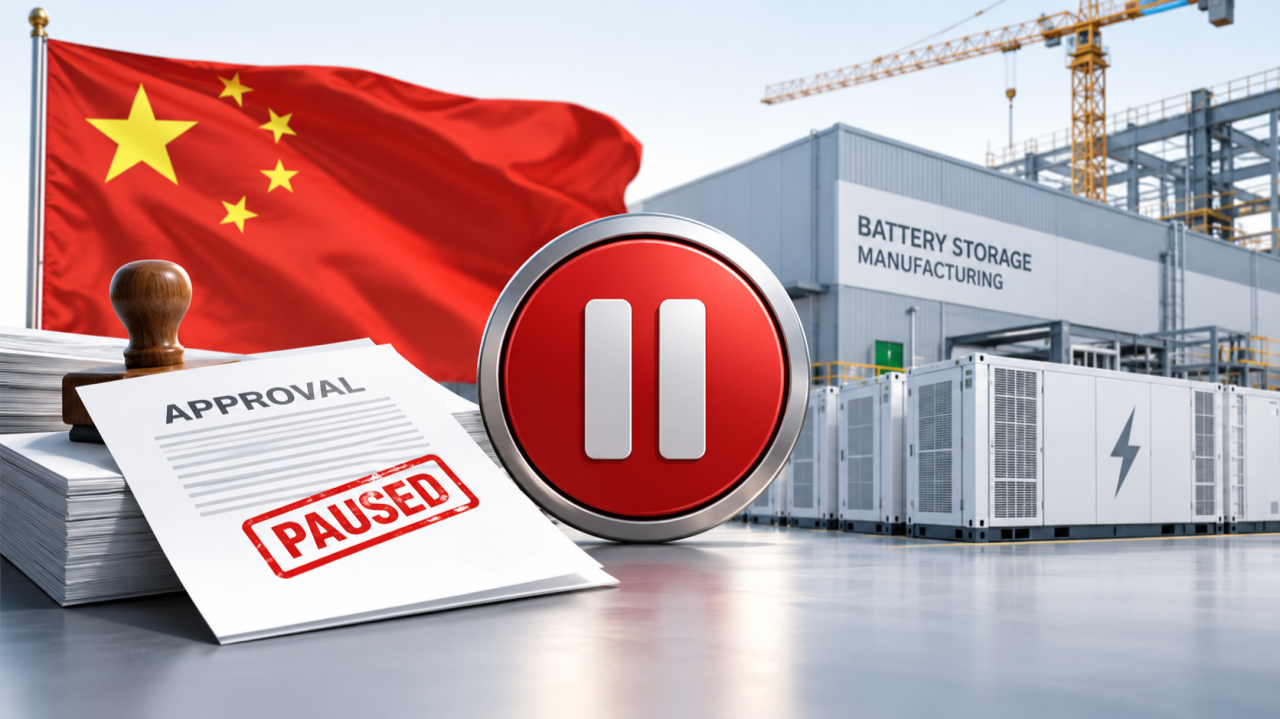
In early September 2026, Chinese financial outlet Cailianshe reported — later confirmed by Reuters and multiple domestic media — that Chinese authorities have temporarily suspended approvals for new battery energy storage system (BESS) factories that have not yet broken ground. The freeze applies specifically to greenfield projects awaiting permits; facilities already under construction are unaffected and will proceed as planned. Authorities, reportedly under the Ministry of Industry and Information Technology, are conducting a comprehensive inventory of existing and planned energy storage capacity, with particular scrutiny on battery cell manufacturing.

The move is explicitly framed as a review, not a permanent ban, and officials have stressed the pause “is neither blanket nor necessarily permanent”. It comes despite surging global demand for grid-balancing and backup-power batteries, underscoring that this is a supply-side correction rather than a demand-side retreat.
The Mechanics, Scope, and Governance of China’s BESS Administrative Pause
The administrative pause enforced by Chinese regulators represents a structured response to an aggressive expansion of manufacturing capacity that decoupled from near-term grid and export demand. Driven by rapid domestic renewable integration targets, municipal industrial subsidies, and aggressive diversification by leading solar photovoltaic manufacturers into stationary battery storage, planned BESS cell capacity in China expanded at an unprecedented pace. Industry disclosures from major manufacturers, including Envision Energy, revealed that cell producers had planned over 800 GWh of additional capacity in 2026 alone, pushing total planned national capacity projections toward 1.2 TWh to 1.5 TWh by year-end, and over 2 TWh overall—a figure far exceeding total global storage demand projections.

This overcapacity led to structural market distortions. The administrative driver of China’s initial domestic demand—a mandatory policy requiring renewable energy projects to pair generation with on-site storage—was formally dismantled by the National Development and Reform Commission (NDRC) and the National Energy Administration (NEA) in early 2025. Stripped of guaranteed regulatory demand, BESS assets were forced to establish commercial viability on pure market economics and merchant arbitrage. Consequently, domestic deployment momentum experienced a relative contraction. In the first half of 2026, China commissioned 21.8 GW / 58.6 GWh of new-type energy storage, representing an 18% decline in power capacity and a 16% decline in energy capacity compared to the same period in the previous year, even as individual project scales grew.
In response to declining asset returns and destructive below-cost price bidding, Chinese industrial planners deployed a multi-stage regulatory intervention:

- Capacity Audits and Policy Warnings: In January and April 2026, MIIT convened symposiums with sixteen major power and energy storage battery companies to establish capacity early-warning systems, tighten oversight on irrational price competition, and crack down on intellectual property violations.
- Fiscal and Tax Adjustments: Authorities reinstated a 2% consumption tax on domestic lithium-ion cell sales while restructuring export tax rebates to harmonize domestic and international market conditions.
- Targeted Greenfield Approval Freeze: Provincial regulatory agencies were directed to hold all paper-stage regulatory filings for unbuilt cell projects pending a comprehensive national inventory review.
- Technical and Safety Standard Revisions: The National Standardization Administration initiated mandatory national standards introducing stringent requirements for active fire detection, thermal runaway suppression, and extended cycle-life verifications.

Simultaneously, Beijing ended an 11-year tax exemption on lithium-ion batteries, introducing a 2% consumption tax from September 1, 2026, rising to 4% in 2027 — while exempting next-generation chemistries like sodium-ion and solid-state batteries through 2028 to preserve its technology lead in those segments.
Global Battery Storage Pricing Dynamics and Landed Import Cost Structures
The intense overcapacity across Chinas manufacturing base drove a historic collapse in battery cell prices between 2021 and early 2026. The benchmark price of Lithium Iron Phosphate (LFP) prismatic cells—the dominant chemistry for utility-scale stationary storage—fell from approximately $280/kWh in 2021 to a historic trough of $47–$55/kWh for Tier-1 and Tier-2 314Ah cells in Chinese spot tenders.

However, the combination of Beijing’s capacity audit, raw material stabilization, and the introduction of the 2% domestic cell consumption tax prompted a price firming across major manufacturers in mid-to-late 2026. Tier-1 manufacturers, led by Contemporary Amperex Technology Co., Limited (CATL) and EVE Energy, adjusted cell quotes upward. CATL raised its 314Ah storage cell pricing to RMB 0.423/Wh (approximately $60/kWh EXW ex-VAT), while EVE Energy passed through the 2% consumption tax surcharge to domestic buyers.

This changing cost structure directly influences import dynamics in international markets, particularly India. As raw cell spot prices adjusted upward to $75–$90/kWh, the tariff differential established by the Indian government between raw cells (10% Basic Customs Duty – BCD) and fully integrated containerized BESS units (20% BCD) expanded in absolute dollar terms. On a $145/kWh turnkey containerized system, the 20% tariff adds nearly $29/kWh in landed duties, whereas importing raw cells at $85/kWh incurs $8.50/kWh in basic duties. This $20.50/kWh landed margin differential expands the protective economic moat for Indian system integrators and battery pack assemblers, even as cell-level manufacturing inside India struggles to commercialize.

Immediate Global Impact: Muted, Not Zero
Because projects already under construction continue unaffected, and China’s existing pipeline is enormous, the near-term effect on global cell supply and pricing is expected to be limited. Saur Energy’s analysis draws a direct parallel to China’s 2025 solar capacity curbs, noting that campaign struggled for eighteen months to meaningfully move prices — suggesting this battery freeze alone is unlikely to quickly reverse the multi-year collapse in global cell prices.
The more consequential question is what happens if this pause evolves from a temporary review into sustained capacity discipline over the next two to three years. In that scenario, the steady price declines that have made Indian BESS tenders cheaper year after year could plateau or even reverse.

India’s Manufacturing Reality Check
While China actively manages excess manufacturing capacity, India operates with a substantial capacity deficit. To establish strategic autonomy and curb import reliance, the Ministry of Heavy Industries (MHI) launched the Production Linked Incentive (PLI) Scheme for the National Programme on Advanced Chemistry Cell (ACC) Battery Storage in May 2021. With a total budgetary outlay of ₹18,100 crore ($2.08 billion), the policy targeted the establishment of 50 GWh of giga-scale cell manufacturing capacity, alongside an additional 5 GWh allocation for niche chemistry lines.

Despite strong initial bidding interest and oversubscribed auctions, project execution has lagged significantly behind policy targets. As of late 2025/2026, only 2.8% (1.4 GWh) of the targeted 50 GWh capacity has been operationally commissioned within the stipulated timelines—delivered exclusively by Ola Electric. Consequently, zero subsidy incentives have been disbursed against the targeted ₹2,900 crore ($332 million) initial payout milestone.

The systemic bottlenecks hindering India’s battery manufacturing expansion stem from a combination of policy design constraints and supply chain dependencies:
- Unrealistic Gestation Schedules: The ACC PLI framework mandated a strict two-year window from the appointed date for greenfield site selection, factory construction, equipment import, dry-room installation, and commercial trial runs. Establishing a functioning giga-scale cell facility typically requires 24 to 36 months under optimal conditions.
- The IEEFA report attributes delays to visa bottlenecks for Chinese technical specialists, unavailability of core cell technology, a skilled manpower gap, and dependence on imported equipment and upstream components — ironically, the same Chinese supply chain India is trying to reduce reliance on. Against a projected 1.03 million jobs, the scheme has generated barely 1,118.

Where India Is Actually Making Progress
Despite the PLI shortfall, private capital is moving. Exide Industries has commenced delivery of locally manufactured NCM cylindrical sample cells from its Bengaluru gigafactory and is in homologation testing with two-wheeler OEMs representing 80-85% of Indian EV volumes, targeting cell revenue from FY27, alongside a joint venture with Great Wall Motor’s SVOLT Energy Technology worth ₹6,000 crore. Amara Raja Energy & Mobility is investing ₹9,500 crore in a Telangana “Giga Corridor” for LFP cells and packs and has taken a speed-to-market approach: a 10 GWh pack-assembly line using imported cells to capture immediate BESS demand while its own cell gigafactory, targeted for commercial production in H1 FY28, completes construction.

The government has also moved to plug the grid-storage gap directly, inviting global bids in July 2026 for an additional 10 GWh of ACC capacity earmarked specifically for grid-scale stationary storage, requiring bidders to hit 25% domestic value addition within two years and 40% within five. India’s underlying demand signal is real: the domestic BESS market is projected to grow at a 29.05% CAGR through 2032, with roughly 10.4 GW awarded in 2025 and a tender pipeline exceeding 90 GWh.
The Missing Piece: A Pull Mechanism
Analysts note India has the demand pipeline but lacks an explicit local-content mechanism for storage — comparable to Brazil’s LRCAP auction, which reserves specific lots for domestically produced equipment — to actively pull relocating Chinese capacity toward Indian soil rather than competing destinations like Egypt or Brazil. Without such a mechanism, Saur Energy argues, the window created by China’s capacity freeze — while Chinese manufacturers are actively scouting a “next stop” — risks closing without India capturing a meaningful share.

No Responses