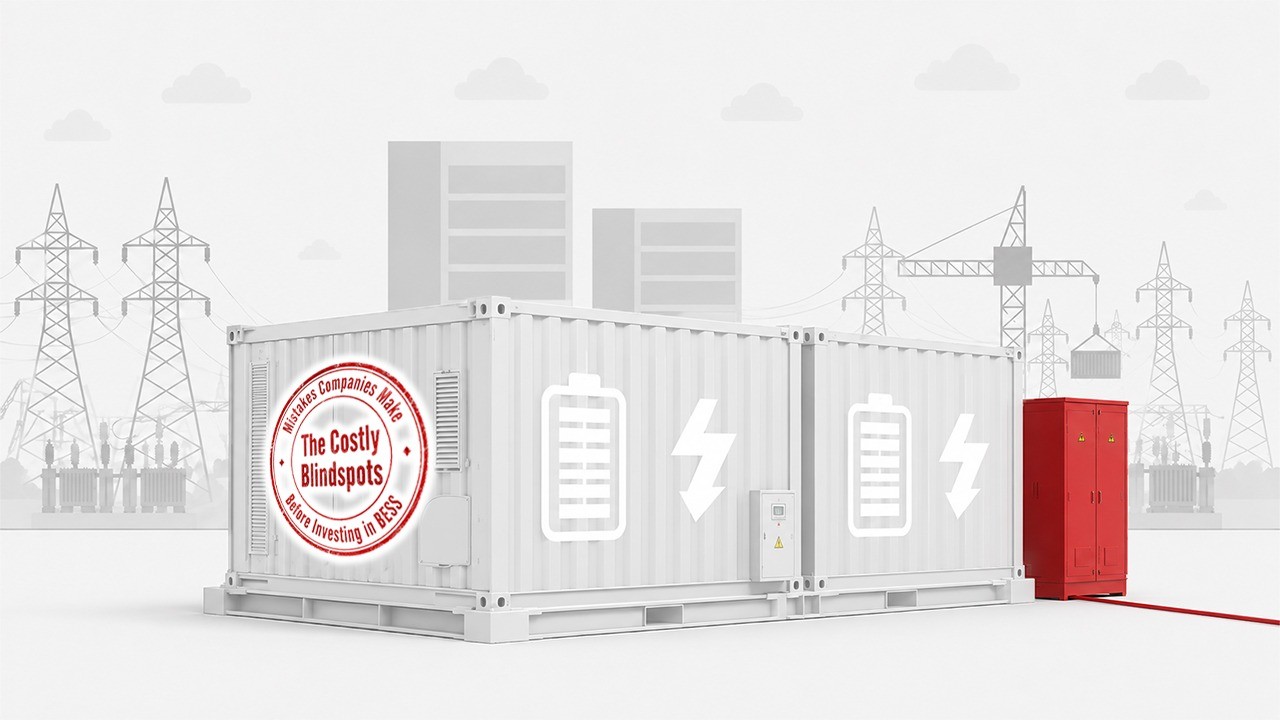
India’s storage rollout has accelerated fast but so has the rate of underperformance. Roughly 6.4 GW of awarded BESS capacity has been cancelled due to PPA delays, financing gaps, and unmet tariff expectations, while some analyses suggest that nearly half of standalone BESS projects show negative returns under realistic financial modeling. These outcomes rarely stem from the battery cell itself — they trace back to decisions made months before a single container is delivered to site. This article breaks down the most common, costly mistakes companies make before investing in BESS, and how to avoid them.

Mistake 1: Chasing Lowest Price Over Lifecycle Value
The single most repeated mistake is selecting a system, integrator, or EPC based purely on the lowest quoted price rather than total lifecycle value. In India’s tender-driven market, this has become a structural problem: the “race to the bottom” philosophy prioritizes headline tariffs over bankability and long-term performance, encouraging underbidding based on speculative future battery price drops rather than current cell economics. Under L1 procurement, battery cells may come from top-tier chemistry, but switchgear, protection relays, and AC-side cabling often go to whoever quotes lowest — engineered, procured, and tested separately with no single quality bar. The consequence is systems that look cheap on paper but carry hidden costs in downtime, augmentation, and safety risk over a 15-20 year asset life.

Mistake 2: Not Defining the Use Case Before Sizing the System
Many companies purchase a BESS before clearly defining how it will actually be used — peak shaving, backup, energy arbitrage, frequency regulation, or renewable firming. Without this clarity, sizing decisions default to guesswork, and companies conflate power (kW) with energy capacity (kWh), leading to systems that are technically undersized for the application even though the headline capacity number looks impressive. Skipping load profile analysis compounds this: without granular consumption data, it’s impossible to right-size the system, resulting in oversized (capital-inefficient) or undersized (performance-shortfall) installations.

Mistake 3: Importing Global Design Templates Without Localization
BESS design in India often imports global templates without adapting them to local conditions, and this “one-size-fits-all” approach is a documented root cause of underperformance. High ambient temperatures accelerate lithium-ion degradation — particularly for NMC chemistries — leading to higher auxiliary consumption and faster capacity fade than global models predict. Many bids assume optimistic degradation curves that ignore the C-rate versus lifecycle trade-off, and system-level engineering that looks sufficient on paper often under-delivers usable capacity once depth-of-discharge limits, PCS losses, and EMS shortcomings are factored in.

Mistake 4: Underestimating Grid Connection and Infrastructure Constraints
Companies frequently evaluate the battery system in isolation without assessing whether the site’s grid connection, transformer capacity, and distribution infrastructure can actually support it. This is not a niche concern in India — much of the distribution network was designed 20-30 years ago for far lower capacity and cannot absorb the additional load without upgrades that developers rarely budget for. On the utility side, this mismatch has created deadlock: distribution companies want battery-backed solar to shift power to evening peak hours, but the 40-50% cost premium that storage adds makes resulting tariffs commercially unpalatable, stalling PPA signings.

Mistake 5: Splitting Procurement Across Uncoordinated Vendors
One of the most consequential mistakes is treating a BESS as a collection of components rather than one integrated system — buying batteries, PCS, and EMS from different vendors purely to minimize upfront capex. When 5-10+ vendors supply interfaces that were never designed to work together, incompatibilities surface as voltage imbalances, HVAC misalignment, and communication protocol mismatches between the BMS, EMS, and PCS. Because no single company owns end-to-end system responsibility, any post-commissioning failure triggers finger-pointing between vendors while the end user absorbs the cost through lost revenue and higher maintenance. A recent Rajasthan installation illustrated this: an AC-side short circuit unrelated to the battery cell or BMS still got reported industry-wide as “a BESS fire,” exposing how fragmented ownership obscures the real point of failure.

Mistake 6: Choosing Integrators Without BESS-Specific Experience
Selecting an EPC or supplier without verified BESS integration experience is a recurring failure mode, especially as bidders from unrelated sectors like real estate and food processing enter the market purely to capture subsidy-driven tenders. EPRI’s global BESS failure database attributes 36% of all incidents to faulty integration, assembly, and construction — the single largest failure category, ahead of operations (29%), design (21%), and manufacturing defects (4%). A core reason: firms treat BESS like a solar plant or conventional generation asset, when it actually demands an interrelated blend of electrical, mechanical, thermal, and software engineering that a solar-only EPC playbook doesn’t cover.

Mistake 7: Skipping Pretesting, Validation, and Commissioning Rigor
A pervasive and preventable cause of delay is failing to pretest and validate system components before site deployment, leaving integration issues to surface during live commissioning instead. This matters because 72% of all BESS failures occur during construction, commissioning, or within the first two years of operation — a window that is entirely within the control of disciplined engineering and procurement practices. Underbid projects typically lack the budget for comprehensive QA, experienced integration teams, adequate commissioning spares, and contingency buffers — precisely the areas where BESS projects are most vulnerable.

Mistake 8: Underestimating Thermal Management Needs
Poor thermal management is one of the most dangerous, and most preventable, failure modes — yet EPCs with limited battery-specific experience routinely underprioritize it. In India’s climate, this isn’t a marginal design consideration: high ambient temperatures directly accelerate cell degradation and raise fire and thermal runaway risk, particularly when combined with cheaper cell sourcing to hit aggressive bid prices. Companies that evaluate a BESS purchase without scrutinizing the cooling architecture are effectively accepting an unquantified safety and performance risk.

Mistake 9: Ignoring Warranty Terms, Augmentation, and Long-Term Service Commitments
Battery warranties vary significantly between manufacturers, yet many buyers focus on the sticker price and treat warranty terms as a formality rather than a core commercial decision. Legal advisors working on battery purchase contracts consistently emphasize that buyers should focus less on the EPC relationship and more on long-term service contracts, availability guarantees, and energy retention guarantees from the OEM or integrator — since batteries typically need to perform for 15 years, often without augmentation built into the original contract. Aggressive bids frequently rely on assumptions about augmentation, warranty durability, and availability that erode once the system is in real operation.

Mistake 10: Overlooking Regulatory and Contractual Interfaces
BESS projects involve unusually complex contracting structures — potentially four separate contracts covering the battery/BMS, PCS/inverters, civil and electrical installation, and the EMS — and companies often fail to map how delays or scope gaps in one contract cascade into another. India compounds this with regulatory ambiguity: the Central Electricity Authority has yet to issue comprehensive guidelines on BESS tariffs, technical parameters, or performance standards, and cost-recovery, wheeling, and banking rules remain unsettled in many states. Companies that don’t build in interface coordination — division-of-responsibility matrices, aligned commissioning sequences, and a dedicated oversight body across OEM and balance-of-plant contractors — routinely find each contractor blaming another when something goes wrong.

Mistake 11: Treating Revenue Forecasts as Fixed Cash Flow
On the financial side, developers often build investment cases around a single-point revenue forecast rather than modeling for market uncertainty across ancillary services, wholesale arbitrage, and balancing mechanisms. Treating a valuation-grade forecast as a guaranteed cash flow — rather than stress-testing it against real market volatility — is described by experienced developers as the most common structural mistake in BESS development, and a heavy dependence on high ancillary revenues in particular is considered a losing strategy.

Building a Pre-Investment Checklist
Companies that avoid these pitfalls generally follow a disciplined sequence before committing capital: defining the use case and running load-profile analysis, verifying grid and transformer capacity, localizing thermal and degradation assumptions to Indian climate conditions, evaluating integrator track record (not just OEM cell quality), consolidating procurement accountability across BMS/PCS/EMS, and stress-testing revenue assumptions rather than relying on a single forecast. Since 72% of failures occur during construction, commissioning, or the first two operating years, front-loading rigor into design, procurement, and commissioning phases is where the highest-leverage risk reduction happens.

No responses yet