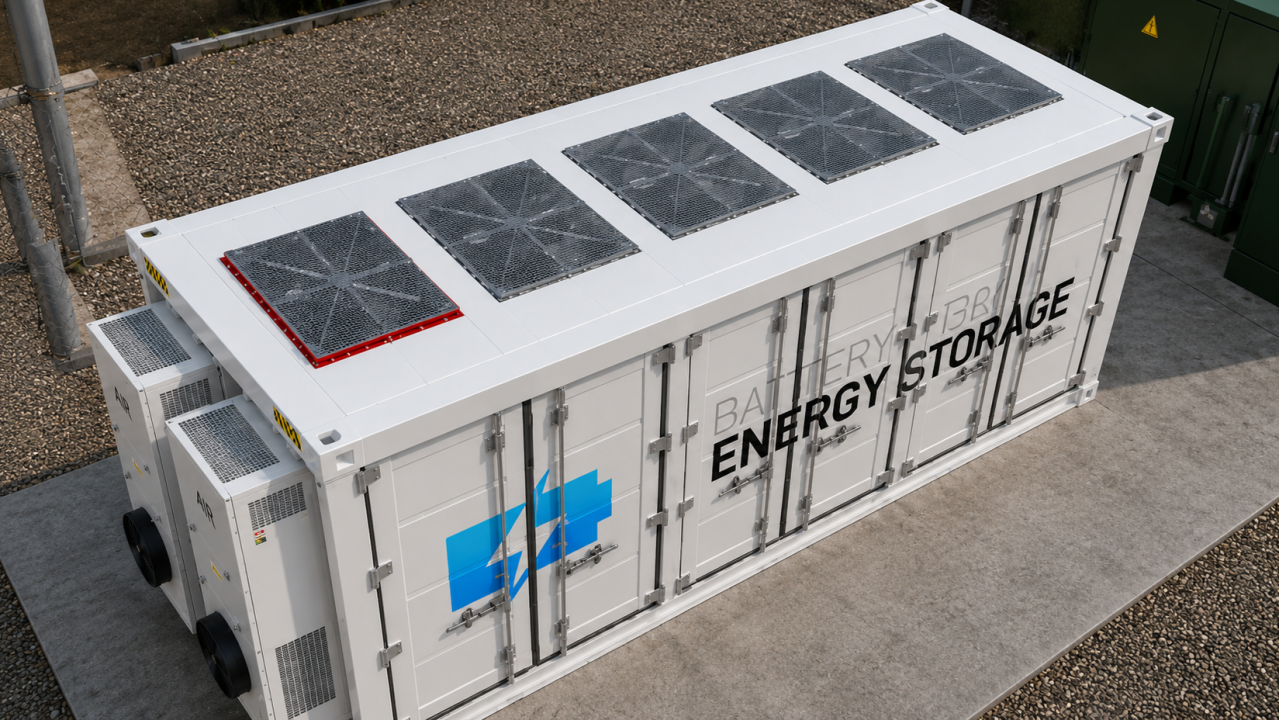
As Battery Energy Storage Systems (BESS) scale to multi-megawatt utility-grade installations, managing the risk of internal overpressure has become one of the most critical challenges in system safety engineering. During thermal runaway events, lithium-ion cells generate substantial quantities of flammable, toxic, and pressurized gases at rates that can rapidly exceed a container’s structural limits. Without properly engineered overpressure protection, a single initiating cell failure can cascade into a deflagration or explosion capable of destroying the entire installation, injuring personnel, and triggering regulatory shutdowns. A layered, multi-level approach — combining passive mechanical relief devices with active gas management systems — is now the accepted industry standard for safe BESS design.

The Root Cause: How Overpressure Builds in a BESS
Thermal Runaway and the Pressure Chain Reaction
The overpressure hazard in BESS originates at the cell level through a phenomenon known as thermal runaway — an uncontrollable, self-sustaining exothermic chain reaction within a lithium-ion cell. Triggered by mechanical damage, external heat, short circuit, or overcharging, thermal runaway drives cell temperatures to over 600°C. In this state, the stored chemical energy in the cell is released violently rather than in a controlled electrochemical process.
As the cell heats, it releases a complex mixture of gases. These include flammable hydrocarbons (ethylene, acetylene, methanol), carbon monoxide (CO), carbon dioxide (CO₂), hydrogen (H₂), and toxic compounds like hydrogen fluoride (HF), hydrogen chloride (HCl), and hydrogen cyanide (HCN). The concentration of CO and HF can rise to dangerously high levels — CO can reach percentage-level concentrations, and HF can exceed hundreds of parts per million (ppm), far above occupational exposure limits. A single 18650 lithium-ion cell, for instance, can release up to approximately 6 liters of gas upon failure. In a large BESS container housing thousands of cells, the cumulative gas volume accumulates with extraordinary speed.

The pressure consequence is direct and severe: as cells fail in sequence, the total gas volume inside the sealed BESS enclosure grows faster than passive leakage or installed ventilation can handle. If flammable gases reach concentrations between their Lower Flammable Limit (LFL) and Upper Flammable Limit (UFL) and find an ignition source, a deflagration occurs — a subsonic combustion wave that generates a damaging overpressure pulse capable of rupturing the container structure, propelling shrapnel, and causing secondary fires.

Why Overpressure in BESS Is Uniquely Challenging
Unlike typical industrial pressure vessels, BESS containers present specific challenges:
- Self-generating oxygen: Lithium-ion battery electrolyte decomposition generates oxygen internally, meaning a fire can sustain itself without external air supply.
- Variable gas composition: The mix and volume of gases depend on cell State of Charge (SOC), chemistry type, and abuse condition, making standardized venting calculations complex.
- Confined geometry: BESS enclosures are typically compact 20-ft or 40-ft shipping container formats where gas accumulation is rapid.
- Cascading propagation: One cell’s failure heats adjacent cells, creating a propagating wave of gas generation that overwhelms systems designed for single-cell events.

Levels of Overpressure Protection
A robust BESS overpressure protection strategy operates at four distinct levels, each addressing the hazard at a different scale of severity.
Level 1: Cell-Level Pressure Relief
The first line of defense is built into every lithium-ion cell. Each cell contains a cell-level safety vent — a pre-scored membrane or burst disc calibrated to open at a defined internal pressure, typically a few bar. When a cell begins to overheat or overcharge, internal pressure rises as electrolyte decomposes and gases form. The vent activates before the cell casing ruptures catastrophically, directing the gas release in a controlled direction through a designed vent path rather than as an uncontrolled structural failure.

Some advanced cells incorporate electric-controlled pressure relief valves (PRVs) that integrate with the Battery Management System (BMS). These electrically actuated PRVs can begin opening within as little as 50 milliseconds of an abnormal condition being detected, providing faster response than purely mechanical vents and enabling pre-emptive gas management.

Level 2: Module and Rack Level
Gas vented at the cell level must be directed safely away from adjacent cells. At the module level, thermal barriers are installed between cells and between cell groups to slow heat propagation and create channelled pathways for escaping gases. This prevents vented gas and heat from one cell from directly impinging on neighbouring cells, buying time for higher-level safety systems to respond.
At the rack level, structural design includes air gaps and chimney-effect channels that route gas upward and away from adjacent modules, reducing the likelihood of ignition or additional thermal stress on nearby battery units. The BMS at the module and rack level continuously monitors voltage, current, and temperature for each cell, triggering alarms and isolation commands if thresholds are exceeded.

Level 3: Enclosure/Container Level — Passive Mechanical Protection
The container level is where the most visible and critical overpressure protection hardware is deployed. Two primary passive mechanical devices are used:
Explosion Vent Panels (Deflagration Vents) These are low burst-pressure membrane panels installed on the roof or sidewalls of BESS containers. They are pre-scored or lightweight membranes calibrated to open at a specific internal pressure threshold — typically as low as 0.05 bar (0.75 psi). When a deflagration event occurs and pressure inside the container rises, the vent panels burst open, rapidly releasing the combustion wave and flammable gases to the atmosphere, away from the container structure. By reducing the peak internal pressure (Pred) below the structural design strength of the container, the panels prevent catastrophic structural failure and shrapnel generation. Vent panels are most commonly installed on the roof so that the resulting flame ball and pressure wave are directed upward and away from personnel and adjacent equipment.

Manufacturers such as BS&B Safety Systems offer around 100 standard vent sizes in both rectangular and round formats, certified to open at designated burst pressures per NFPA 855, NFPA 68, NFPA 69, EN 14491, and EN 14797.
Rupture Discs Rupture discs are single-use, precision-engineered devices installed in pressure relief pathways. They burst instantaneously at a pre-determined pressure, providing zero-leakage containment during normal operation and near-instantaneous response during an overpressure event. Unlike vent panels, which are designed primarily for deflagration scenarios, rupture discs are suited for managing rapid liquid or gas overpressure in enclosed piping, cooling systems, and battery module housings. Their no-moving-parts design makes them maintenance-free, but they require replacement after activation since they are single-use devices.
The key difference between vent panels and rupture discs is summarized below:

Level 4: Active Gas Management — Combustible Concentration Reduction (CCR)
The most advanced and increasingly mandated layer of overpressure protection is the active explosion prevention approach based on NFPA 69. Rather than merely managing the consequences of a deflagration, CCR systems work to prevent the explosive gas concentration from ever being reached.
A CCR system deploys gas sensors to continuously monitor flammable gas concentrations within the BESS enclosure. Upon detecting rising gas levels, the system triggers forced ventilation — typically via explosion-proof fans or HVAC systems — to dilute the gas with fresh outside air, keeping the concentration below 25% of the LFL as required by NFPA 69. At concentrations below 25% LFL, there is insufficient flammable gas for a deflagration to occur even in the presence of an ignition source, preventing the pressure event entirely.

Key design requirements for CCR systems include:
- Gas composition characterization: Quantifying the type and volume of flammable gases produced from UL 9540A testing data
- Failure scenario modeling: Using CFD (Computational Fluid Dynamics) to validate that ventilation design achieves 25% LFL dilution under worst-case scenarios
- Operational resilience: The system must remain functional during failure scenarios, including loss of grid power, using dedicated backup power supplies
- Hazardous gas migration management: Preventing gas generated in one BESS unit from migrating to adjacent interconnected units
The Role of the BMS in Overpressure Prevention
The Battery Management System (BMS) is the intelligent “brain” that coordinates the entire overpressure protection strategy. A modern BESS BMS operates across three hierarchical levels:
- Cell/Module BMS (BMU): Monitors individual cell voltage, current, and temperature in real-time; triggers cell isolation on fault detection.
- Rack BMS (RBMS): Aggregates module-level data, manages rack-level protection relays, and communicates faults upward.
- System BMS (SBMS): Oversees the entire BESS system, interfaces with the EMS and SCADA, activates system-wide protective actions, and communicates with emergency response systems.

When the BMS detects thermal anomalies, it triggers a cascade of protective actions: disconnecting the affected module from the string, activating cooling systems, signaling the CCR/ventilation system to begin operation, and raising alarms for site personnel and remote monitoring centers. This early intervention is critical — if thermal runaway can be arrested before significant gas generation occurs, the need for mechanical overpressure relief is eliminated.
Applicable Standards and Regulatory Framework
Overpressure protection design for BESS is governed by an evolving set of international standards. The table below summarizes the most critical applicable codes:

The 2026 NFPA 855 Shift: A Pivotal Regulatory Change
The 2026 edition of NFPA 855 represents a significant philosophical shift in how the industry approaches BESS explosion hazards. Key changes include:
- HMA is now the default, not the exception. Every BESS installation must complete a formal Hazard Mitigation Analysis regardless of system size, forcing rigorous safety analysis early in the design process.
- NFPA 68 deflagration venting is no longer sufficient as a primary control. The regulatory community has determined that merely venting a deflagration after it occurs is inadequate — the emphasis has moved to preventing the explosion from happening in the first place through NFPA 69 active prevention.
- CCR systems must be operationally resilient. Explosion prevention systems must remain functional during worst-case failure modes, including loss of auxiliary power, with dedicated backup supply.
- Large-scale fire testing is required. Manufacturers must support compliance with installation-level fire and explosion testing data, not just cell or module-level test results.

Emerging Technologies and Best Practices
Layered / Defense-in-Depth Approach
The industry consensus has converged on a defense-in-depth strategy that combines multiple, redundant layers of protection rather than relying on any single mechanism:
- Prevention — BMS-based early detection, state-of-charge management, and active cooling to stop thermal runaway before it starts
- Early intervention — Gas sensors and pre-ventilation triggered at the earliest detectable stage of thermal runaway (elevated CO or HF concentration before full thermal runaway onset)
- Passive relief — Rupture discs and explosion vent panels as fail-safe backstops against catastrophic overpressure
- Active dilution — NFPA 69-compliant CCR systems to maintain safe gas concentrations
- Containment — Fire-rated compartmentation and separation to prevent propagation to adjacent BESS units
CFD Modeling for Ventilation Design
Computational fluid dynamics (CFD) modeling has become an essential design tool for validating CCR system performance. Because the geometry of BESS containers creates complex gas flow patterns that are difficult to assess analytically, CFD simulations verify that forced ventilation achieves sufficient dilution throughout the enclosure volume — including dead zones and corners — under worst-case gas generation scenarios. CFD is particularly important for installations with multiple interconnected BESS units, where gas migration between enclosures must be modelled.

Failsafe Passive Venting Panels
Some advanced BESS designs incorporate failsafe venting panels that open passively by natural convection alone, without requiring any power or electronic actuation. This addresses the scenario where a severe thermal runaway event coincides with a loss of auxiliary power, which would otherwise disable active CCR systems and leave only passive relief devices as the last line of defense. The combination of active CCR systems plus failsafe passive venting panels has been described by manufacturers as an “NFPA 69++” design philosophy.
Electric-Controlled Pressure Relief Valves
Research into electrically actuated pressure relief valves integrated directly with the BMS represents a next-generation approach to cell-level protection. These systems, capable of activating within 50 milliseconds of fault detection, allow the BMS to pre-emptively manage internal cell pressure before the safety vent threshold is reached, potentially preventing venting gas from entering the module enclosure entirely. This reduces the volume of flammable gas released into the broader container environment.

Consequences of Inadequate Overpressure Protection
High-profile BESS incidents globally underscore the importance of getting this right. The Gateway Energy Storage Facility fire in California and the Daxing Energy Storage Station explosion in Beijing both illustrated the catastrophic potential of inadequate gas and pressure management in large-scale BESS. A deflagration event in an insufficiently protected container can result in:
- Structural destruction of the container and adjacent units
- Shrapnel generation from ruptured steel panels, posing immediate personnel risk
- Secondary fire propagation to adjacent containers, significantly amplifying financial and environmental losses
- Toxic gas releases at levels dangerous to first responders and nearby communities

Importantly, environmental assessments of 35 major BESS fire incidents in the United States from 2012 to 2024 found that airborne toxic emissions tend to dissipate quickly and do not pose public health concerns beyond the immediate fire scene, provided gas management and fire response protocols are followed. This underscores that well-designed overpressure and gas management systems, combined with proper emergency response planning, can substantially contain the impact of even a severe event.
Conclusion
Overpressure protection in BESS is not a single device or standard — it is a systemic, multi-layered engineering discipline that spans from individual cell design to container-level explosion prevention. The fundamental physics of lithium-ion thermal runaway make gas generation and pressure accumulation an unavoidable hazard that must be managed proactively.
The industry’s direction, codified in NFPA 855 (2026) and reinforced by global incidents, is clear: prevention of explosive gas accumulation through active CCR systems must be the primary strategy, with passive vent panels and rupture discs serving as critical fail-safe backstops. For developers, integrators, and manufacturers operating in the rapidly expanding BESS market, early investment in hazard analysis, rigorous testing, and multi-layer protection engineering is both a regulatory requirement and a prerequisite for safe, bankable projects.

No Responses