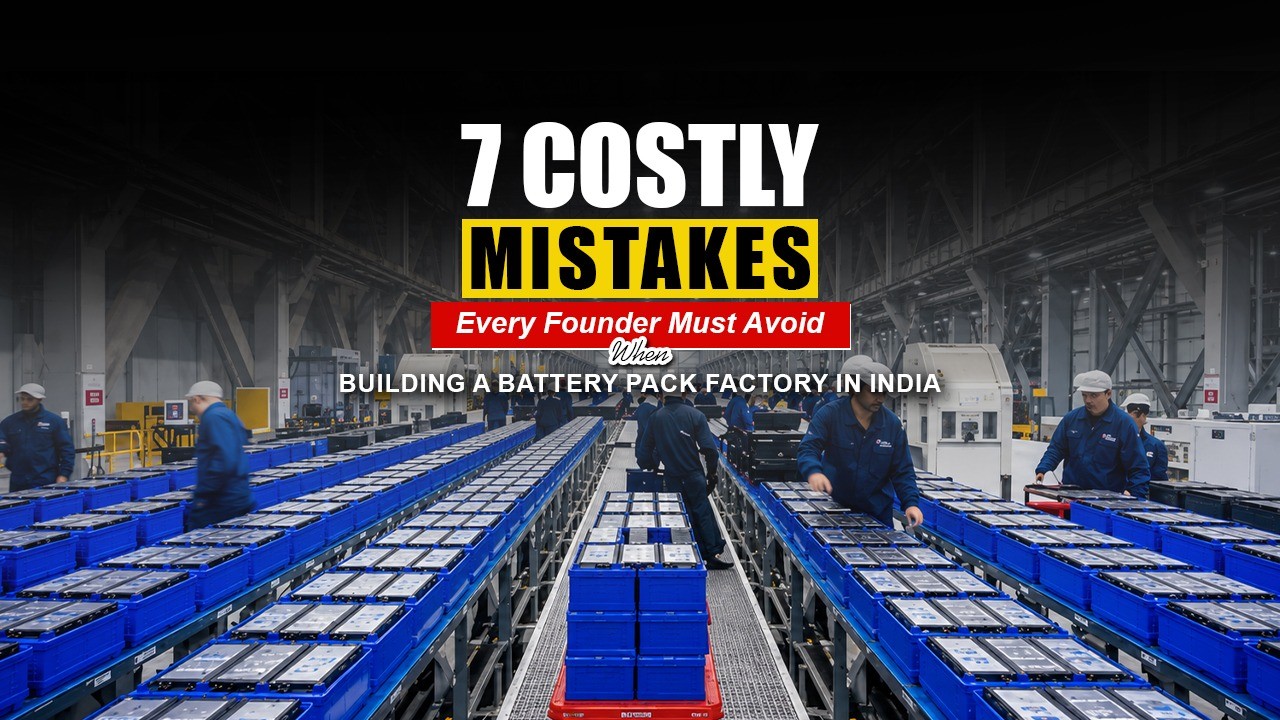
India’s battery manufacturing and energy storage industry is growing at an unprecedented pace. With government initiatives such as the ACC PLI Scheme, VGF support for BESS projects, rising EV adoption, and ambitious renewable energy targets, many entrepreneurs and industrial groups are planning to establish Battery PACK, RACK, and BESS manufacturing facilities.
However, setting up a battery manufacturing facility is far more complex than renting a building, purchasing machines, and hiring operators. Over the last few years, India has witnessed several successful battery manufacturing projects—but also many delays, cost overruns, failed commissioning attempts, and operational challenges.
If you are planning to establish a Battery PACK or BESS manufacturing plant in India, these are the seven most common mistakes that can significantly impact your timeline, profitability, and customer confidence.

Mistake 1: Believing that “renting/building a factory is all it takes to start operations”
One of the biggest misconceptions among first-time manufacturers is believing that once a factory building has been rented or purchased, production can begin immediately. Unfortunately, battery manufacturing does not work that way. A building that appears suitable from the outside may be completely inadequate for the technical and safety requirements of battery production.
Many project developers discover too late that:
- Available electrical power is insufficient
- Transformer capacity cannot support charging and discharging equipment
- Floor loading is inadequate for heavy automated production lines
- Fire safety systems do not meet regulatory requirements
- Environmental approvals become difficult
- Utility upgrades require significant additional investment

In India, these challenges become even more critical due to the rapid scale at which BESS and EV battery manufacturing projects are being developed.
For example, a facility initially planned for a few hundred MWh of annual production may quickly expand to multiple GWh. If the electrical infrastructure has not been designed with future growth in mind, expensive retrofitting becomes inevitable.
Before finalizing any facility, companies should conduct detailed assessments covering:
- What power supply capacity is needed? Is it enough? If not, who will bear the cost and timeframe for expansion?
- What is the floor load-bearing capacity? What kind of treatment is needed for the floor (e.g., should it be a wear-resistant emery floor?) The PACK line equipment is heavy, so the floor of a regular factory building may need to be reinforced.
- Will it pass the fire safety inspection? PACK factories are generally classified as Class C factories, and there are strict requirements for sprinkler systems, smoke extraction, and fire compartmentation.
- Are there any prerequisites for environmental impact assessment, energy assessment, and safety assessment? Some industrial parks may not allow the assembly of battery cell modules.
- What methods are used for heating or cooling?
In short: a factory building cannot be used immediately after it is rented or built. It needs to be “checked out” or you need to participate in the design. You also need to prepare a list of factory building requirements in advance based on your own needs.
Contact Semco Infratech to discuss your EV & BESS manufacturing requirements and discover how automatic assembly solutions can enhance your production efficiency, ensure product quality, and accelerate your path to market competitiveness.
For demos: Connect at sales@semcoindia.com | +91-8920681227 | www.semcoinfratech.com
Mistake 2: The team was assembled too late, or the wrong people were assembled.
Many promoters believe that hiring can wait until the equipment is delivered. This approach almost always results in delays. Battery manufacturing equipment is highly specialized. Installation, commissioning, process validation, and operator training all require experienced personnel who understand the technology.
When equipment arrives before the technical team is in place, the result is predictable:
- Delayed commissioning
- Extended trial production periods
- Increased debugging cycles
- Low initial yields
- Dependency on equipment suppliers

India currently faces a shortage of experienced battery manufacturing professionals. While talent is available, demand has grown significantly faster than supply. The most successful projects begin recruiting key personnel months before equipment installation.
The first hires should include:
- Process Engineer (Person 1) He is responsible for production line design, equipment selection, and process validation.
- Equipment Engineer (2nd position) He is responsible for commissioning and maintenance after the equipment arrives on site.
- Production Supervisor (3rd position) He is responsible for participating in trial production and training operators.
- Quality Engineer (4th position) He is responsible for establishing inspection standards and coordinating with customer audits.
Mistake 3: Selecting Equipment Based Only on Price
In every project, there is pressure to reduce capital expenditure. Unfortunately, this often leads companies to select equipment based purely on purchase price. This decision can become extremely expensive later.
Battery manufacturing equipment is not simply machinery—it is the foundation of product quality, production efficiency, and customer confidence. A lower-cost laser welding machine, leak tester, EOL tester, or automation system may initially appear attractive. However, if it suffers from poor accuracy, unreliable performance, limited software integration, or weak after-sales support, the long-term consequences can be severe.

More importantly, process engineers must be involved in the entire selection process. Procurement only considers price, while process engineers understand whether the product is suitable.
Mistake 4: Treating Quality Systems and Certifications as a Last Step
Many new factories focus exclusively on production and postpone quality systems until customer audits begin. This is a serious mistake. Battery manufacturing is one of the most traceability-intensive industries in the world.
Customers increasingly expect complete visibility into:
- Raw material records
- Process controls
- Inspection reports
- Calibration status
- Operator training records
- Equipment validation documents

Attempting to create this documentation retrospectively is almost impossible. By the time audits begin, missing records become obvious. Instead, factories should establish documentation systems from the very first day of project execution. Every activity should be recorded Equipment FAT, SAT, IQ/OQ/PQ validation, Process qualification, Training records, Maintenance records and Change management activities. Building the quality culture early dramatically simplifies future certifications and customer approvals.
Mistake 5: Underestimating MES and Digital Traceability
Today, nearly every modern battery factory plans to implement MES. However, purchasing software is easy. Getting people to use it correctly is difficult. Many factories discover that operators Skip scans, use incorrect material codes, bypass procedures and enter incomplete information. The result is broken traceability.
In a battery manufacturing environment, traceability failures can become catastrophic during customer investigations or warranty claims. Successful MES implementation requires more than technology. It requires User-friendly interfaces, Extensive operator training, Process discipline, Barcode & QR integration and Management commitment.

The objective is not merely collecting data. The objective is ensuring that every battery can be traced from incoming material to final shipment. In an era of global quality expectations, digital traceability is becoming a competitive advantage rather than a compliance requirement.
Mistake 6: Depending on a Single Supplier for Critical Components
Supply chain disruptions have become a reality across the battery industry. Whether caused by geopolitical events, logistics delays, raw material shortages, customs issues, or regulatory changes, supply interruptions can halt production overnight. Yet many factories continue relying on a single supplier for critical components. This creates enormous risk.

Core battery components such as: Cells, BMS, Connectors, Busbars, Cooling systems and Structural parts should always have qualified backup suppliers. The goal is not simply purchasing from multiple vendors. The goal is ensuring that alternative components are validated, approved, and production-ready before a disruption occurs.
Mistake 7: Believing Mass Production Is the Finish Line
Many teams celebrate when production finally begins. In reality, mass production is where the real challenge starts. Once customer shipments commence, pressure increases significantly. factories must continuously manage: Yield improvement, Quality performance, Cost reduction, Productivity enhancement, Safety compliance & Customer expectations. Without continuous improvement programs, performance gradually deteriorates.

Experienced manufacturers understand that operational excellence is a daily discipline. The most successful factories conduct: Daily Gemba Walks, Weekly Quality Reviews, Monthly Yield Analysis, OEE Tracking, Root Cause Investigations, Safety Audits and Continuous Improvement Workshops.
Conclusion
India’s battery manufacturing industry is entering a transformational decade. Gigawatt-hour-scale factories are being announced across the country. BESS deployments are accelerating. EV demand continues to grow. Government policies are increasingly supporting domestic manufacturing. The opportunity is enormous. However, success in battery manufacturing depends far less on ambition and far more on execution. The factories that will dominate the next decade will not necessarily be those with the largest investment budgets.

No Responses