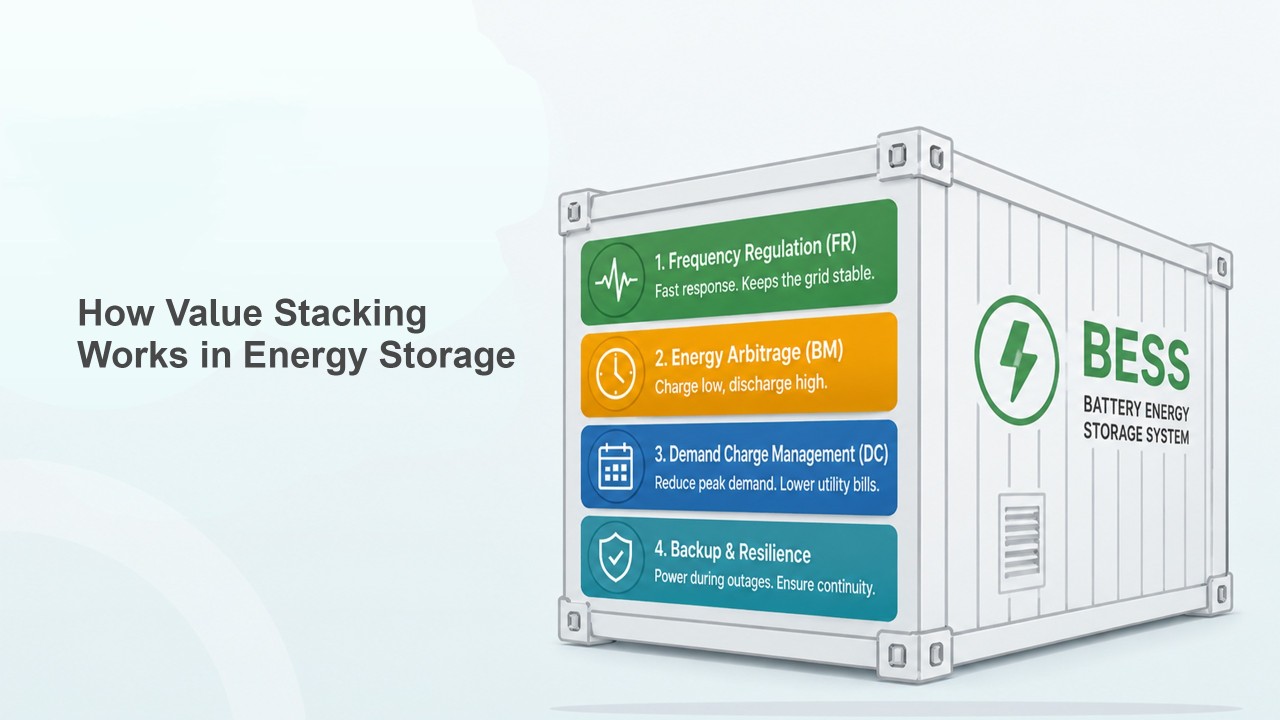
A battery energy storage system (BESS) is one of the most capital-intensive assets in the energy sector. Relying on a single application — energy arbitrage, frequency regulation, or peak shaving alone — rarely generates returns sufficient to justify that investment. Value stacking is the discipline of layering multiple revenue streams onto the same physical asset, so each stream adds incremental value without requiring additional hardware. When done correctly, a well-optimised value stack can improve project IRR substantially, making projects that look marginal on a single-use basis economically robust and bankable.
This article explains the core mechanics of value stacking, walks through each major value stream, discusses how to sequence and co-optimise them, addresses the real-world constraints that shape every stack, and closes with considerations specific to the Indian regulatory environment.
What Is Value Stacking?
At its simplest, value stacking means operating a BESS across multiple applications simultaneously or sequentially, so the same kilowatt-hours and kilowatts earn revenue from more than one source. A 10 MWh battery does not have to choose between providing frequency regulation or doing energy arbitrage — it can do both, as long as capacity is allocated intelligently and dispatch windows do not conflict.

The term “multi-use operation” or “service stacking” is also used in academic literature; the concept is the same. What distinguishes sophisticated value stacking from naive multi-use operation is co-optimisation — the dispatch logic that actively balances competing claims on battery capacity in real time to maximise total portfolio revenue while respecting system constraints.
The Core Value Streams
Value stacking opportunities fall into two broad deployment contexts — Behind the Meter (BTM) and Front of the Meter (FTM) — depending on where the value is created.
Behind-the-Meter (BTM) Value Streams
BTM applications create value inside a facility by reducing electricity costs for the host customer.
1. Demand Charge Management (Peak Shaving) Demand charges, billed based on the highest 15- or 30-minute peak consumption interval in a billing period, can represent a substantial share of a commercial or industrial electricity bill. A BESS discharges during these peak windows, “shaving” demand and directly reducing the utility bill. This stream forms the foundation of most BTM revenue stacks because it runs daily, does not depend on external grid events, and generates predictable returns.
2. Time-of-Use (TOU) Energy Arbitrage Where utilities apply time-varying rates, a BESS charges during low-price off-peak periods (often daytime or overnight) and discharges during expensive peak pricing windows (typically evening hours). This “buy low, sell high” mechanism reduces net electricity costs and is one of the most accessible and consistent value streams for behind-the-meter deployments.

3. Solar PV Self-Consumption / Renewable Firming In cases where exported solar generation is not compensated at the same rate as grid electricity purchases, a BESS can absorb excess midday solar production and discharge it later to offset utility imports. This improves the value of the on-site renewable asset while reducing grid dependency.
4. Backup Power / Resilience Resilience remains a foundational driver of BESS investment. The value of maintaining critical loads during a grid outage is tied to the cost of downtime — highly significant for cold storage, data centers, hospitals, or manufacturing facilities. While difficult to monetize directly, resilience drives BESS sizing decisions and underpins the investment case.
Front-of-the-Meter (FTM) Value Streams
FTM applications generate revenue by delivering services to the grid through wholesale markets or utility programs.
5. Wholesale Energy Arbitrage Utility-scale batteries can buy energy in day-ahead or real-time markets when prices are low and sell (discharge) when prices are high. According to the U.S. Energy Information Administration (EIA), 66% of all utility-scale battery capacity in the United States had arbitrage among its uses in 2024, with 41% of total capacity primarily used for arbitrage — making it the most prevalent single use case.
6. Frequency Regulation Frequency regulation involves maintaining the grid’s frequency at the prescribed level (e.g., 60 Hz in North America, 50 Hz in India and most of the world) during rapid fluctuations in supply or demand. Batteries excel at this service: they can respond in milliseconds, far outpacing conventional thermal generators that require minutes to ramp. Frequency regulation was historically the most common primary use case for utility-scale batteries; it now ranks second to arbitrage as markets have evolved.
7. Spinning and Non-Spinning Reserves Reserves are commitments of standby capacity that the grid operator can call upon rapidly in contingency situations. Batteries can participate in multiple ancillary service markets — including Regulation Up, Regulation Down, Spinning Reserve, and Non-Spinning Reserve. In CAISO (California), for instance, storage can simultaneously participate in all four ancillary markets, which can represent a major share of annual revenue.

8. Capacity Market Participation (Resource Adequacy) Capacity markets compensate assets for being available to generate during peak demand periods, rather than paying for every unit of energy delivered. Resource Adequacy (RA) contracts in CAISO have become the majority revenue source for many batteries in California — with contract prices rising 75% over five years and RA revenues now accounting for over half of total revenue for most CAISO battery systems. In Great Britain, the Capacity Market contributed a record 30% of total battery revenue in December 2023.
9. Demand Response Programs Demand response (DR) programs pay asset owners to reduce or shift electricity consumption during grid stress events. Batteries can either reduce their own consumption or discharge to reduce load on behalf of a host facility or an aggregator. DR adds contracted, event-driven revenue on top of daily operations.
10. Transmission and Distribution (T&D) Deferral Strategically sited storage can reduce congestion on distribution or transmission lines, delaying or avoiding costly infrastructure upgrades. Utilities may compensate storage project owners for this service through bilateral agreements or utility-specific programs.
11. Virtual Power Plant (VPP) Aggregation Individual BTM batteries can be aggregated into a virtual power plant, pooling their capacity to participate in wholesale markets or grid programs that require larger minimum bid sizes. VPP programs allow smaller assets to access FTM revenue streams they could not access individually.
The Three Layers of a BESS Revenue Stack
All battery revenue streams fall into three behavioural categories. Understanding these categories is the first step to building a sound stack.

Layer 1: Bill Savings — The Foundation
Bill savings include demand charge management and time-of-use (ToU) arbitrage. These are the most predictable revenue streams because they are tied directly to utility rate structures and repeat every billing cycle. The battery charges during off-peak, low-price periods and discharges during peak demand windows to reduce the facility’s maximum demand recorded by the utility.
This layer forms the anchor of any revenue stack for behind-the-meter (BTM) or commercial-and-industrial (C&I) installations. It is also relevant for utility-scale projects co-located with industrial consumers. Because the dispatch pattern is predictable, it is easy to model, easy to finance, and easy to verify.

Layer 2: Contracted Grid Services — The Amplifier
This layer includes frequency regulation, primary and secondary reserve provision, capacity market participation, and demand response (DR) programs. Revenue here is partially fixed (availability payments) and partially event-driven (activation payments).
Because these services pay for availability as much as for energy, the battery can reserve capacity for potential dispatch while still performing lower-priority tasks the rest of the time. This property is what makes them ideal middle-layer revenue streams — they amplify total value without fully consuming the battery’s energy budget.
For grid-scale projects, this layer is often the largest revenue contributor. In India, frequency regulation through POSOCO/Grid-India pays ₹10–15 lakh/MW-month in availability fees plus activation payments, and modelled NPV for a 100 MW system over 15 years has been estimated at ₹150–200 crore from this stream alone.

Layer 3: Energy Market Participation — The Opportunistic Upside
Energy arbitrage — buying from the grid or charging from co-located renewable generation when prices are low and selling back when prices are high — constitutes the opportunistic layer. In India, IEX day-ahead market prices range from ₹8–12/kWh during peak hours, while off-peak prices can be significantly lower, creating arbitrage spreads that BESS can capture.
This layer is the most variable. Arbitrage margins compress when solar and wind penetration rises (as has already happened in Tamil Nadu and Rajasthan), and market rules differ significantly across jurisdictions. It should enhance the stack, not anchor it.

The Complete Map of BESS Value Streams
The table below summarises all major value streams applicable to BESS projects, their revenue mechanism, time horizon, and typical priority in a stack.

The Role of the EMS in Value Stacking
The Energy Management System is the operational intelligence that makes value stacking possible at scale. Without it, a BESS can store and release energy — but it cannot intelligently allocate capacity across competing revenue streams.
A modern BESS EMS performs three core functions for value stacking:
1. Forecasting: The EMS ingests weather data, solar generation forecasts, and historical market price data to predict when energy will be cheapest and most expensive. For systems co-located with solar, it forecasts generation hour-by-hour to plan when to store and when to discharge.
2. Revenue Stacking Logic: At the heart of the EMS is a co-optimisation engine — often formulated as a Mixed Integer Linear Programming (MILP) problem — that continuously evaluates all available revenue streams and allocates battery capacity to maximise total portfolio value subject to physical and contractual constraints. A simplified real-time rule set might look like:
- Reserve 20% capacity for frequency regulation (market signals are strong)
- Commit 30% to energy arbitrage during the predicted 5–7 PM price peak
- Deploy 50% for demand charge management to protect the facility’s billing
- Maintain a 10% safety margin at all times

3. Degradation-Aware Dispatch: Every charge-discharge cycle earns revenue but accelerates battery ageing. A sophisticated EMS incorporates a degradation model that only authorises additional cycling when the incremental revenue exceeds the incremental degradation cost. This is particularly important for value stacking — more active stacks cycle the battery more, and without degradation awareness, the short-term revenue gain can erode long-term capacity and bankability.
Constraints That Every Stack Must Respect
Value stacking is bounded by physics, regulation, and economics. Four constraints shape every real-world stack:
Finite Energy Capacity: A battery has a fixed number of kWh per cycle. Once that energy is committed to one service, it is unavailable for others until the system recharges. This is the fundamental scarcity that makes prioritisation non-trivial.
Degradation and Lifecycle Trade-offs: Cycling generates revenue but also degrades the battery. Lithium-ion cells lose capacity with each cycle and with time, independent of use (calendar ageing). High-cycling stacks that chase every arbitrage opportunity can cut battery life significantly. Research confirms that multi-use operation, when done correctly, can actually reduce calendar ageing by keeping SoC away from extreme levels — but only if the stack is designed with degradation awareness.

Regulatory and Market Rules: Not all revenue combinations are permitted in every market. Some capacity programmes require exclusive commitments during contracted periods. Others prohibit simultaneous participation in two ancillary service categories. In India, the CERC Ancillary Services Regulation 2026 now explicitly permits simultaneous participation in energy markets, frequency regulation, and secondary reserves — a significant change from the previous single-service paradigm.
Co-optimisation Complexity: As the number of stacked services grows, the optimisation problem becomes combinatorially complex. Stochastic co-optimisation models that account for forecast uncertainty, SoC limits, POSOCO penalties, and degradation are computationally demanding and require specialist software.
The German BESS Evolution
This market transition is highly visible in Germany, where grid-scale battery storage capacity is projected to scale from 5 GW in 2026 to 40 GW by 2040. This growth is driven by the consistent expansion of renewable energy under the Renewable Energy Sources Act (EEG), rising price volatility (with Germany recording 575 negative-price hours in 2025), and declining hardware costs. Historically, the German market was dominated by the Frequency Containment Reserve (FCR). However, the FCR market has saturated, forcing operators to adapt.

German battery operators now stack FCR with the Automatic Frequency Restoration Reserve (aFRR) and active wholesale trading:
- aFRR Stacking: Unlike FCR, aFRR includes separate capacity and energy payments for positive and negative balancing services. During periods of tight system conditions, negative aFRR revenues have cleared as high as €17,100/MW per month, while positive aFRR has averaged €7,000/MW.
- Wholesale Arbitrage and Intraday Settlement: German intraday spot markets offer significant volatility, with continuous intraday trading clearing at €15,400/MW per month. The introduction of 15-minute settlement in October 2025 quadrupled the temporal resolution of spot trading, providing more tradable intervals and generating a projected 25% uplift in arbitrage revenue potential.

Value Stacking in the Indian Context
India’s BESS value stacking landscape has undergone a structural shift in 2026. Prior to this year, standalone BESS projects in India derived most revenue from energy arbitrage on the Indian Energy Exchange (IEX) — a single, thin revenue source that made standalone economics challenging, pushing developers toward SECI hybrid tenders (RE + storage bundled).
The CERC Ancillary Services Regulation 2026, approved in March 2026, changes this fundamentally:
- It establishes a unified framework for primary, secondary, and tertiary reserves
- BESS is explicitly eligible to participate in all three categories
- Pricing shifts from regulated to market-based
- Settlement is at 15-minute granularity

Modelled total revenue under this framework is estimated at 30–50% higher than energy-only operation for standalone BESS. A conservative revenue model for Indian utility-scale BESS now allocates approximately 60% to energy markets, 30% to reserve services, and 10% to other value streams such as T&D deferral or capacity payments.
Additionally, AI-powered EMS platforms designed for CERC compliance are now operational in India, enabling sub-50ms frequency response and simultaneous co-optimisation across IEX, POSOCO, and DISCOM capacity contracts. The remaining execution dependencies — Grid-India operationalising the secondary reserve market (expected Q3 2026) and state-level regulatory alignment — will determine how quickly developers can capture the full theoretical uplift.
Sizing Analysis: 2-Hour vs. 4-Hour Systems
As ancillary markets saturate, the optimal storage duration is shifting toward longer-duration assets. To illustrate the long-term economics of this shift, the table below compares the performance of a 2-hour battery system against a 4-hour battery system for a 2026 Commercial Operation Date (COD) in Germany.

Quantifying the Business Case
Value stacking directly improves the investment case in measurable ways:
- Revenue uplift: Stacking ancillary services on top of energy arbitrage delivers 50–70% of total revenue from ancillary services on IEX/POSOCO platforms for optimally positioned projects
- T&D deferral value: Resilience value from deferring distribution network upgrades can save ₹1.68 crore+ annually on demand charges in high-load states
- Payback period: With value stacking, utility-scale BESS payback periods in India are modelled at 4–8 years against a capex of ₹4–6 crore/MWh
- MILP optimisation gains: Academic studies show that advanced co-optimisation models can deliver a 17.3% profit increase compared to simpler individual chance-constraint methods
- Degradation alignment: Multi-use operation, when properly managed, reduces the need to purchase energy on day-ahead markets and keeps SoC away from saturation regions — both of which improve battery lifetime

Common Pitfalls to Avoid
Even well-intentioned value stacks fail when practitioners make these errors:
- Over-committing capacity — Enrolling in too many programmes with overlapping dispatch windows. A smaller, coordinated stack consistently outperforms an overbuilt one
- Treating arbitrage as the foundation — Price spreads fluctuate and compress over time. Projects that rely primarily on arbitrage are exposed to market risk thesis.
- Ignoring degradation in dispatch logic — Running the battery hard to maximise short-term revenue without accounting for accelerated ageing erodes long-term bankability
- Static dispatch scheduling — Using a fixed charge/discharge schedule fails to capture intraday and seasonal value opportunities
- Regulatory non-compliance — Participating in services without understanding exclusivity rules or metering requirements can result in POSOCO penalties and disqualification
Conclusion
Value stacking is not a feature — it is the business model for energy storage in modern power markets. A BESS that serves only one application leaves significant revenue on the table and struggles to meet its cost of capital. The discipline lies in building the stack methodically: anchoring with predictable foundation-layer revenue, amplifying with contracted grid services, and topping with opportunistic market participation — all coordinated by an intelligent EMS that continuously balances competing claims on capacity.

In India, the regulatory infrastructure to enable full value stacking is now in place with the CERC Ancillary Services Regulation 2026. The window for first-mover advantage in tariff discovery and market positioning is open. Developers, project financiers, and asset managers who master the mechanics of value stacking today will build projects that outperform those designed around single-revenue assumptions — and define the economics of India’s storage sector for the next decade.
No Responses