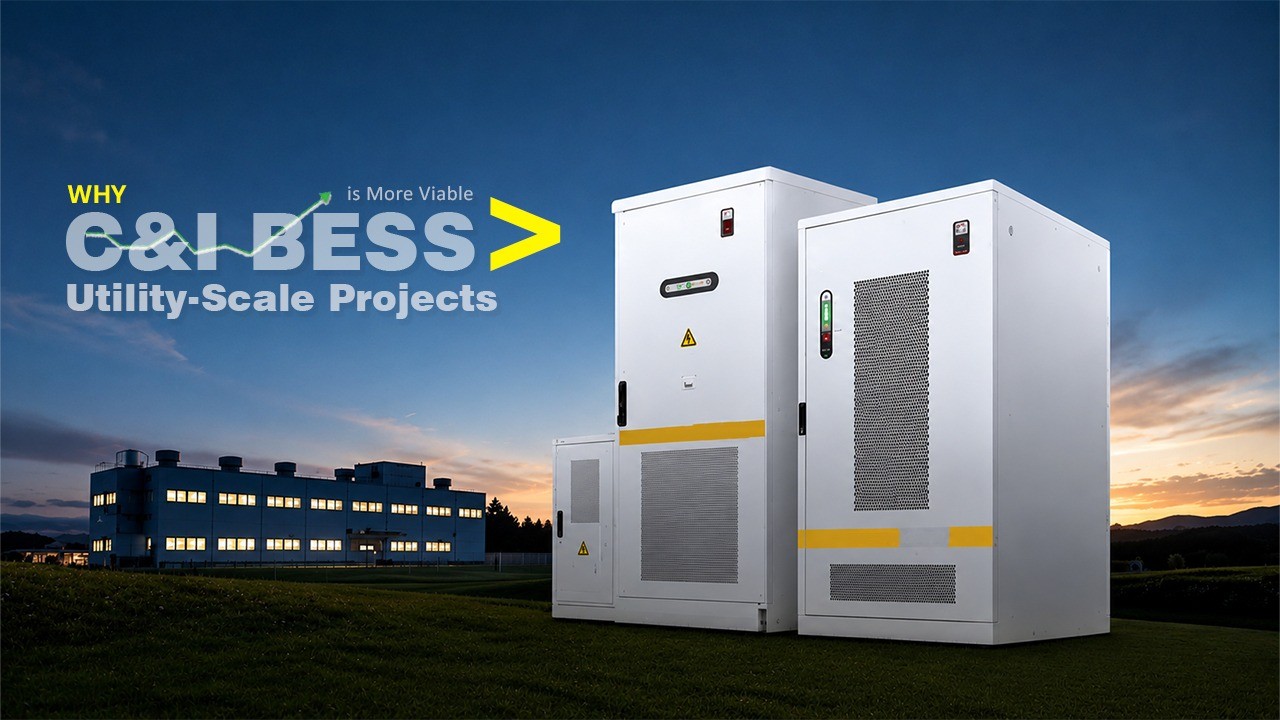
Battery Energy Storage Systems (BESS) are broadly classified into two deployment segments: utility-scale projects (front-of-meter, 5 MW to 1 GW+) and commercial & industrial (C&I) installations (behind-the-meter, 30 kW to 5 MW). While utility-scale BESS dominates headlines with gigawatt-scale tenders and national grid mandates, C&I BESS is rapidly emerging as the more commercially viable and execution-reliable segment — particularly in the Indian market.
The global C&I BESS market is forecast to reach USD 21.64 billion by 2035, growing more than three times its current size, and the sector is projected to reach 560 GW of cumulative installed capacity globally by 2035. In India, behind-the-meter BESS installations for C&I customers have already crossed 1.2 GWh by April 2026, with the segment identified as the fastest-growing storage application in the country.

The case for C&I BESS rests on a convergence of faster payback periods, simpler regulatory pathways, modular scalability, and diversified revenue streams — advantages that utility-scale projects, burdened by long development cycles, grid connection queues, and aggressive tariff underbidding risks, currently cannot match.
The Core Distinction: Behind the Meter vs. Front of Meter
Understanding the viability argument requires clarity on how each segment operates.
C&I BESS operates behind the customer’s meter. It serves a single facility or campus — shaving peak demand, replacing diesel backup power, integrating rooftop solar, and reducing time-of-use (ToU) tariff costs. The decision-maker is the facility owner, energy manager, or an Energy Service Company (ESCO). Deployment timelines are measured in weeks to months.
Utility-scale BESS connects to transmission or distribution networks. It sells services to grid operators, firms renewable intermittency, and arbitrages wholesale electricity prices. The decision-maker is an Independent Power Producer (IPP), utility, or infrastructure fund. The development timeline stretches two years or more.

A critical takeaway from this distinction: C&I systems are products. Utility-scale systems are infrastructure projects. This fundamental difference shapes every dimension of viability — from capital allocation to risk management.
1. Faster Payback and Superior Economics
The financial case for C&I BESS in India is now compelling and, increasingly, irrefutable.
Retail Tariff Arbitrage vs. Wholesale Price Exposure
C&I BESS displaces electricity at retail tariff rates — ranging from ₹7 to ₹12/kWh during peak hours in most Indian states. Utility-scale BESS, by contrast, participates in wholesale electricity markets where prices are structurally lower, and revenue depends on ancillary service frameworks that remain nascent in India. The economic leverage of retail tariff arbitrage is simply superior.

Demand Charge Management: A High-Value Revenue Stream
Demand charges — billed on the single highest 15-minute peak load interval in a billing month — represent a disproportionately large share of C&I electricity bills. In Maharashtra and Karnataka, demand charges range from ₹400–600/kVA/month. A C&I BESS sized to clip this peak can eliminate a significant recurring cost with no exposure to grid tariff policy or PPA negotiations.
In markets with high demand charge structures, payback periods for C&I BESS now range from 2–5 years, compared to 4–8 years for utility-scale projects. In India specifically, typical 1–10 MWh behind-the-meter installations achieve payback in 4–6 years through ToD arbitrage and demand charge management alone.

Time-of-Day Tariff Spreads Widen the Opportunity
State utility commissions in Maharashtra, Karnataka, and Gujarat introduced steeper time-of-day tariff differentials in 2024–2025, with peak-versus-off-peak spreads now reaching ₹4–6/kWh in some states. This creates a structural, tariff-guaranteed revenue stream for C&I BESS that does not require participation in market auctions or complex power purchase agreement structures.
The Diesel Displacement Advantage
In India, where diesel generator backup is ubiquitous across manufacturing, healthcare, and commercial facilities, C&I BESS offers a particularly powerful economic proposition. The true all-in cost of diesel backup power — including fuel, maintenance, AMC, and the invisible cost of the 10–30 second switchover gap (which causes production loss events, PLC resets, and material wastage) — reaches ₹31–35/kWh. BESS delivers equivalent backup at ₹7–9/kWh from grid charging.
For a 500 kVA facility with 200 outage hours per year, the net annual operating margin improvement from switching to BESS is approximately ₹17.8 lakh — a 53% reduction in total backup power cost, flowing directly to EBITDA. At current diesel prices of ₹88–102/litre across most Indian states, virtually every C&I facility with a 125 kW+ DG set is in positive cash flow territory from the first month of BESS operation.

2. Faster Deployment, Lower Execution Risk
Commissioning in Weeks, Not Years
C&I BESS design favours compactness and speed. A 500 kW/1 MWh system fits within a single 20-foot container or existing electrical room, with commissioning achievable in days to weeks. Pre-engineered, factory-tested containerised units — available in modular 10-foot or 20-foot increments — can be installed without major civil works.
Utility-scale BESS, by contrast, is heavy civil engineering. A 100 MW/400 MWh plant requires 20–80 containerised battery units, medium-voltage switchgear, station service transformers, a dedicated substation, and extensive site grading and fire suppression zoning. EPC cycles stretch months to years.

The Grid Connection Queue Problem
India’s utility-scale BESS pipeline is severely bottlenecked by grid connection delays. The country has auctioned approximately 12.8 GWh of BESS capacity between 2022 and May 2025, yet only about 219 MWh is reported as operational. The gap is largely attributable to delays in power purchase agreement signing, grid interconnection queues, and transmission constraints — particularly in renewable-rich states where evacuation infrastructure is lagging.
Building transmission lines and substations takes three to six years in India. C&I BESS, connecting at the distribution or facility level, bypasses this entirely. The grid connection requirement is limited to existing metering infrastructure.

Land Acquisition: A Hidden Utility-Scale Burden
Utility-scale projects require greenfield land, with acquisition timelines of 6–9 months even under streamlined processes. Local objections, missing NOCs, and documentation inconsistencies routinely add months of delay. C&I BESS is installed on existing facility premises — a rooftop, an electrical room, or a paved compound — eliminating land acquisition as a project risk entirely.
3. Regulatory Simplicity and Policy Tailwinds for C&I
Behind-the-Meter: A Lighter Compliance Burden
Utility-scale BESS projects in India require grid code compliance with CERC’s revised regulations (which include state-of-charge disclosure to SLDC/RLDC, metering at both AC and DC boundaries, and sub-200 ms frequency response requirements). They require interconnection studies, environmental clearances, and participation in regulated tariff auctions — a process that, at scale, takes 18–24 months from auction to commissioning, not accounting for PPA delays.
C&I BESS operates under a far simpler framework: local DISCOM tariff structures, standard building codes, and fire safety requirements. CEA technical standards and BIS certifications apply, but the regulatory footprint is a fraction of utility-scale requirements.

Policy Support Maturing for C&I
India’s BESS policy landscape is increasingly recognising behind-the-meter opportunities. Time-of-day tariffs are now mandatory nationwide, creating standardised economic triggers for C&I storage adoption. The Production-Linked Incentive (PLI) scheme and Viability Gap Funding (VGF) support domestic battery manufacturing that benefits system pricing across both segments. The CERC’s revised grid code for the first time treats BESS as a defined asset class, opening ancillary services participation even for distributed assets.
4. Revenue Stacking Without Market Complexity
The C&I Revenue Stack
A well-designed C&I BESS system in India can simultaneously generate value from multiple streams:
- Peak shaving: Reducing demand charges by clipping peak load intervals
- Time-of-use arbitrage: Charging during off-peak hours (cheaper), discharging during peak hours (expensive)
- Solar self-consumption: Storing excess rooftop solar generation for evening use, improving utilisation from ~60% to over 85%
- Diesel backup replacement: Eliminating DG operating costs and the switchover gap penalty
- Power quality improvement: Voltage stabilisation, reactive power correction, harmonic mitigation
- Grid services (emerging): Frequency response participation as market frameworks mature

This stacking occurs autonomously through an intelligent Energy Management System (EMS), requiring no active participation in wholesale electricity markets or complex bidding frameworks.
Utility-Scale Revenue: Sophisticated but Fragile
Utility-scale BESS revenues depend on participation in ancillary services markets, wholesale energy arbitrage, and capacity payment mechanisms. In India, the ancillary services market currently relies primarily on thermal plants, and clear guidelines for BESS participation remain incomplete. ERCOT data from the US shows that total ancillary service costs per MWh fell 74% in 2024 as BESS capacity expanded — illustrating how utility-scale BESS can compress its own revenue streams as the market saturates.
The C&I revenue stack, by contrast, is driven by retail tariff structures — which are relatively stable, regulated, and independent of market competition dynamics.
5. The Utility-Scale Risk Landscape in India
India’s utility-scale BESS sector is navigating a challenging period that underscores the structural advantages of C&I deployment.
Aggressive Underbidding in Auctions: Since 2022, standalone BESS tariffs in India have witnessed a sharp decline, with the lowest discovered tariff dropping to INR 1.48 lakh per MW per month for 2-hour systems — significantly below the benchmark estimate of INR 2.3 lakh/MW/month considered necessary for financially sustainable operations. Researchers estimate that nearly 75% of allocated 2-hour BESS capacity currently falls into the “at-risk” category.

Financing Constraints: Utility-scale BESS projects in India face financing costs 300–400 basis points higher than vanilla renewable energy projects, due to complexities in FDRE contracts, lack of battery performance track records, and uncertainty over future battery replacement expenditure. C&I BESS, by contrast, is increasingly available on operating lease structures where the system provider retains asset ownership and technical risk — making it off-balance-sheet OpEx with no CapEx approval required.
Supply Chain Dependencies: India’s BESS sector remains heavily dependent on lithium-ion battery technology and China-centric supply chains. While this risk affects both segments, utility-scale projects — which commit to multi-GWh procurement plans — carry disproportionate exposure to geopolitical supply disruptions. C&I deployments, with smaller and more frequent procurement cycles, can adapt more quickly to alternative chemistries (sodium-ion, LFP from domestic manufacturers) as they become available.
C&I vs. Utility-Scale BESS: A Direct Comparison

Note: Utility-scale CAPEX is lower per kWh at scale, but soft costs (interconnection studies, civil works, substation) significantly raise total project cost.
6. Sectoral Demand Driving C&I Growth in India
The Indian C&I BESS market is being driven by identifiable, high-value sectors where energy reliability and cost optimisation are operationally critical.
Manufacturing Sector: Textile, chemical, food processing, and automotive component manufacturers are the dominant adopters. These facilities combine high energy intensity, exposure to peak demand charges, frequent grid outages (particularly in UP, Haryana, and Rajasthan), and process sensitivity to the diesel switchover gap — making the economic case for BESS compelling on multiple dimensions simultaneously.
Data Centres: Data centres represent the most sophisticated C&I BESS application. Through intelligent EMS, data centres can draw power during lower-cost off-peak periods and discharge during peak demand — reducing demand charges while providing sub-millisecond backup that eliminates the risk of data loss during grid events. With India’s data centre capacity expanding rapidly in the context of AI and cloud demand, this segment is emerging as a high-margin C&I BESS opportunity.

Commercial Real Estate and Hospitality: Large commercial complexes, malls, and hotels are increasingly deploying hybrid solar-plus-storage configurations. Projects designed from inception with integrated solar and BESS benefit from co-optimised sizing, simplified financing structures, and integrated energy management platforms. As green building certifications become standard, on-site storage is transitioning from optional to baseline.
Healthcare and Critical Infrastructure: Hospitals, pharmaceutical cold chains, and airport operations require uninterrupted power quality that diesel backup cannot guarantee. BESS provides <10 ms switchover (versus 10–30 seconds for DG), eliminating the process-disruption risk entirely. For these facilities, the value case extends beyond economics to operational risk mitigation.
7. The Modular Advantage: Scalability Without Commitment
One of the most underappreciated C&I BESS advantages is modularity. Modern containerised BESS systems are engineered in modular 1–5 MWh blocks that can be added incrementally as demand grows. This allows facilities to start with a financially conservative deployment — validating performance and payback — before expanding capacity.
Utility-scale projects require full upfront commitment to system sizing, substation infrastructure, and grid interconnection capacity. The modular C&I approach is far better suited to a market where technology costs continue to fall and business energy profiles are evolving.

Furthermore, containerised units can be relocated between sites — particularly valuable for EPCs managing multiple industrial or commercial clients, or for leasing models where the asset moves with the business relationship.
The Road Ahead: C&I BESS in India’s 2026–2030 Energy Landscape
India’s BESS market is at a structural inflection point. The pipeline capacity multiplied fivefold to 92 GWh in 2025, and the market is projected to grow from USD 1.5 billion in 2025 to USD 7.5 billion by 2030 at a 33% CAGR. Within this broader growth narrative, the C&I segment is positioned to outpace utility-scale on three dimensions: execution reliability, financial returns, and stakeholder accessibility.

The Central Electricity Authority projects India’s storage demand will rise from ~82 GWh in 2026–27 to over 400 GWh by 2031–32. Achieving this scale requires not just large grid-tied projects, but a distributed deployment strategy — one that C&I BESS, with its faster commissioning, lower land requirements, and simpler financing, is uniquely positioned to deliver.

As ToD tariff differentials widen, demand charge structures mature, and LFP battery prices continue their structural decline (with Indian market installed costs at USD 230–270/kWh as of 2026), the C&I BESS business case will only strengthen. The question for India’s manufacturing, commercial, and infrastructure sectors is no longer whether to adopt BESS — it is how quickly and at what scale.
Conclusion: Speed, Simplicity, and Superior Returns
The utility-scale BESS narrative is real and important — grid stability, renewable firming, and large-scale energy arbitrage are legitimate and necessary value propositions. But utility-scale viability in India currently requires navigating underbidding risks in competitive auctions, 18-month PPA signing delays, multi-year grid connection queues, and complex financing structures with elevated costs of capital.
C&I BESS offers a fundamentally different proposition: faster deployment, immediate cash flow from retail tariff arbitrage, modular scalability, and minimal regulatory friction. It serves the facility owner where they are — replacing diesel, managing demand charges, maximising solar utilisation — with no dependency on evolving grid market frameworks.

The C&I segment’s 4–6 year payback against utility-scale’s 4–8 years may appear similar in isolation. But in India’s current execution environment — where only 219 MWh of the 12.8 GWh auctioned utility-scale capacity has been commissioned — the operational reality heavily favours C&I. Deployment that actually happens, at attractive retail tariff economics, with bankable performance data, will consistently outperform theoretical utility-scale returns on paper.
For developers, ESCOs, energy managers, and CFOs evaluating India’s energy storage opportunity, the C&I segment offers the clearest path from contract to commissioning to cash flow — and that execution advantage may be its most decisive edge.
No Responses