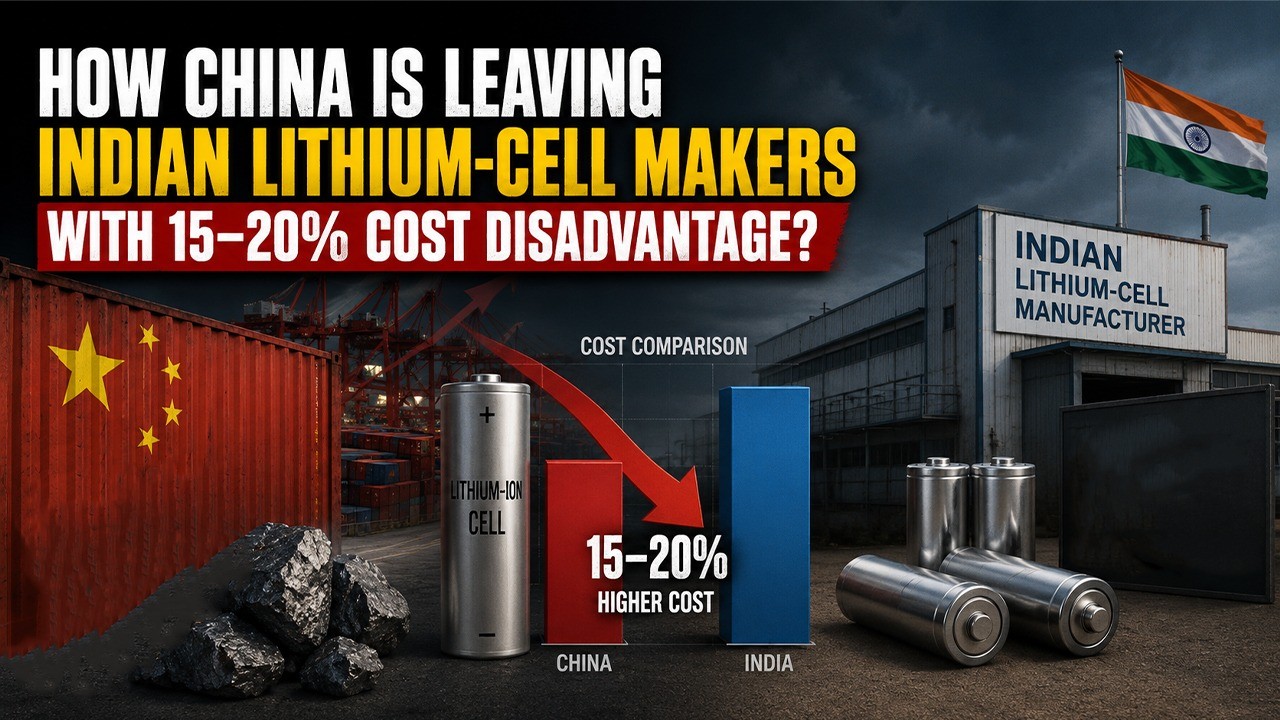
The global transition toward clean mobility and renewable energy integration has elevated Advanced Chemistry Cell (ACC) lithium-ion battery manufacturing into a critical pillar of national industrial strategy. However, India’s nascent battery manufacturing sector faces a severe price disadvantage of 15% to 20%—and initial cost premiums as high as 20% to 25%—when competing directly against imported Chinese lithium-ion cells.
Indian lithium-ion cell manufacturers face a structural cost disadvantage of roughly 15–20% against Chinese suppliers, a gap driven by scale, raw-material dependence, financing costs, and China’s tightening grip on the upstream supply chain. Exide Energy’s leadership has publicly confirmed this figure, attributing it “largely to China’s deeper supply chain.” This report unpacks why the gap exists, how it is quantified, and what levers India has to close it.

Deconstructing the 15–20% Cost Disadvantage
The price gap articulated by domestic industrial leaders highlights a fundamental economic reality: assembling battery packs locally is cost-competitive in India, but manufacturing the underlying lithium-ion cells is not. When Indian companies import finished cells and integrate them with localized structural enclosures and Battery Management Systems (BMS), they operate on relatively even footing. However, greenfield cell production within India immediately encounters compounding cost premiums across raw material procurement, scale economies, and yield efficiencies.
Global manufacturing benchmarks compiled by industrial analysts place China as the absolute cost baseline for lithium-ion cell production. Comparative regional analysis shows that cell manufacturing in Southeast Asia carries roughly a 10% cost premium over China, whereas production in Europe and North America carries a ~40% cost premium due to elevated labor rates, high capital expenditure, and stringent environmental compliance costs. India sits between these regions, bearing an initial cost handicap of 15% to 25% over Chinese imports.

Upstream Monopolization and Bill-of-Materials Disadvantages
The primary driver of Indias cell-level cost penalty lies in the Bill of Materials (BOM), which constitutes 60% to 70% of total cell manufacturing costs. China commands a structural monopoly over the upstream processing and chemical synthesis of critical battery inputs. Specifically, China refines approximately 74% of global battery-grade lithium, 80% of global cobalt, and 35% of global nickel. More critically, Chinese chemical processors control over 98% of global Lithium Iron Phosphate (LFP) Cathode Active Material (CAM) production.
Because India possesses near-zero commercial capacity for refining raw minerals or manufacturing active cathode powders and anode graphites, domestic cell makers must import these precursors directly from Chinese suppliers. In 2025 alone, India imported 18,200 tonnes of lithium compounds worth $1.2 billion (₹11,160 crore), with China supplying 68% of these inputs and Chile supplying 24%. Importing active materials adds international freight, insurance, cross-border logistics, and customs clearance friction, inflating input costs by 10% to 15% before cell production begins. Furthermore, Chinese suppliers regularly offer active materials to domestic cell makers at lower prices than to foreign buyers, compounding the disadvantage for Indian manufacturers.

The Scale of the Gap
Multiple independent assessments converge on a cost disadvantage in the 15–40% range depending on the metric used. Exide’s own management pegs the structural gap at 15–20% on a cell-cost basis. Wood Mackenzie estimates that locally manufactured Indian cells cost 25–40% more than imported Chinese cells, largely due to limited scale, higher financing costs, and an underdeveloped supplier ecosystem. SMM’s analysis similarly finds domestically made cells carry a 25–40% premium over imports because India’s cell-input supply chain remains almost entirely dependent on Chinese and Korean intermediate materials.
On landed pricing specifically, JMK Research and IEEFA found Indian buyers paid 13–23% more for imported LFP cells than Chinese domestic buyers in July 2026, with landed prices of $62–67/kWh in India versus about $54.5/kWh in China — a gap of $7–12/kWh driven by freight, duties, and import-related costs. Separately, cell and component prices from China have been quoted as 25–40% cheaper than India’s on a component basis, per Nomura Research Institute and industry executives.

Why China’s cells are cheaper
Scale and capacity dominance
China controls roughly 85–98% of global capacity across nearly every node of the battery supply chain — cathode, anode, separator, and electrolyte — and has cumulative commissioned cell capacity of about 2,695 GWh, compared with just 2 GWh commissioned in India as of 2026. This scale advantage alone accounts for a large share of the disadvantage smaller manufacturers face: Porsche Consulting research cited by IISD found that “size matters when it comes to building battery cell factories — smaller players are generally at a 15–20% disadvantage in costs per cell compared to large-scale volume manufacturers.” Because India lacks comparable giga-scale plants, it inherits this scale penalty by default.

Cheaper labor and electricity
A bottom-up cost model from KTH found China has the lowest cell production cost among countries studied, with cheap labor alone contributing about $5.1/kWh in savings versus baseline, plus lower electricity costs (roughly $0.09/kWh cheaper) that further compress costs. India, by contrast, was found to have the highest cell production costs among countries studied, primarily due to high industrial electricity costs adding roughly $11/kWh to cell cost, with total production costs $4.3/kWh higher than the general benchmark.

Raw material and component dependence
India imports nearly all its cell-grade critical minerals and intermediate materials. China supplies an estimated 63–85%+ of India’s lithium-ion cell imports, and the components feeding even India’s “domestic” pack-assembly plants — cathode active materials, anodes, separators, and electrolytes — are sourced almost entirely from Chinese and Korean manufacturers. Cells alone account for 75–80% of the total cost of a finished lithium-ion battery, meaning India’s near-total reliance on imported cells (rather than domestically produced ones) locks in the disadvantage at the most cost-sensitive stage of the value chain. Exide and Amara Raja, despite having commissioned giga factories in India, still source cathode powder, electrolyte, and graphite almost entirely from China, and expect this dependency to persist for three to five years.

Deep chemistry know-how
Beyond raw materials, China holds a technological edge that is difficult to replicate quickly. Ashim Sharma of Nomura Research Institute notes that “the chemistry of lithium-ion cells has been developed and mastered by Chinese companies, which is difficult to recreate unless there are heavy investments in research and development.” Indian firms can localize some components, but the deepest value — cell chemistry optimization — remains concentrated in China.

Export policy levers
China has periodically used tax and export policy to protect its cost edge. A VAT exemption for battery exports is being phased out, with an incremental 3% VAT increase already implemented and a further 6% expected by January, cumulatively raising imported cell costs to Indian buyers by about 9%. Separately, China’s export rebate on cells (currently 6%, down from 9%) is set to disappear entirely from January 1, 2027, which Exide’s leadership expects will show up directly in landed import costs. China has also tightened export controls on synthetic graphite anode materials and core production equipment (pelletization reactors, graphitization furnaces, coating modification devices) effective November 8, 2025, extending its 2023 graphite export-permit regime into a broader “material-equipment-technology” governance framework.

India’s Cost Structure: Strengths and Weaknesses
India is not without competitive fundamentals — its underlying cost position is described as “globally competitive,” with a 154% cost advantage over Japan and a 9% advantage over South Korea, ranking second only to China among major manufacturing destinations, according to Wood Mackenzie. India also benefits from comparatively cheap labor and competitive industrial tariffs; an IEA study found Indian capital costs for clean-energy technologies including batteries were significantly lower than the EU and US, though still 20–90% higher than China’s. The core problem is not India’s underlying factor costs but the absence of scale, an integrated domestic supplier base, and up-to-date market pricing power — all of which China has built over more than a decade.

The PLI Scheme: Ambition versus Delivery
India’s flagship policy response, the ₹18,100 crore ($2.08 billion) Advanced Chemistry Cell (ACC) Production Linked Incentive scheme launched in October 2021, aimed to build 50 GWh of domestic cell manufacturing capacity by 2025 to cut import dependence. As of October 2025, only 2.8% (1.4 GWh) had been commissioned within the stipulated timeline — entirely by Ola Electric — while Reliance New Energy is the only other beneficiary on track for its 10 GWh second-round allocation. Investment has also lagged: roughly ₹28.7 billion ($330 million) has been committed against a targeted ₹112.5 billion, and no incentive payouts have been disbursed against a planned ₹29 billion, four years after launch.
Bottlenecks cited by the Ministry of Heavy Industries include unavailability of technology, a skilled manpower gap, dependence on imported critical equipment, and non-availability of upstream components — with the government forced to grant Ola Electric and Reliance a two-year extension, pushing the incentive window to FY27–FY31. Ola Electric has also scaled back its near-term plans, limiting commissioned capacity to 5 GWh until FY2029, which further dilutes the scheme’s original ambitions. In July 2026, the government launched a fresh global tender for 10 GWh of ACC capacity specifically for grid-scale stationary storage, requiring bidders to commit to at least 25% domestic value addition within two years and 40% within five years.

China’s own Price Volatility Complicates the Picture
Notably, the cost gap is not static — Chinese cell prices themselves have been volatile through 2026. After years of decline, mainstream 314Ah cell prices in China rose over 30% between January and March 2026, and CNESA data shows winning bid prices for 4-hour storage systems up 21.1% year-over-year in H1 2026, driven partly by a doubling of lithium carbonate futures after Beijing cut export tax rebates on batteries and materials. Even so, bulk best-in-class Chinese LFP cells were transacting around $75–78/kWh in early 2026 versus a global average of $84/kWh, and platforms like CATL Mall have pushed direct-to-buyer pricing as low as $63/kWh for 314Ah cells, undercutting distributor margins and reinforcing China’s price leadership even amid a broader upward correction. Separately, China’s new battery consumption tax — a 2% rate from September 2026 rising to 4% from September 2027 — will add incremental cost pressure to Chinese-made cells, offering India a narrow, policy-driven window to close part of the gap.

Raw Material access as the next battleground
India’s long-term fix depends on raw-material self-sufficiency, which remains distant. Geological Survey of India exploration has identified 10.88 million tonnes of lithium resources in Jammu & Kashmir’s Salal-Haimna and Kotla areas, alongside deposits in Rajasthan, but these remain unexploited reserves rather than active mining and refining capacity. SMM analysis projects India’s battery supply chain will need 10–15 years to achieve meaningful self-sufficiency, with upstream critical minerals — lithium, cobalt, nickel, and graphite — sourced at near-100% import dependency today. Cumulative EV cell imports alone hit $4.6 billion in FY26, with more than two-thirds sourced from China, underscoring the scale of near-term dependency.

Outlook
Closing the 15–20% gap will likely require a combination of forces working simultaneously: China’s own rising costs (from VAT/export-rebate changes and lithium price volatility), faster PLI execution and disbursement, deeper domestic value addition mandates on new tenders, and eventual raw-material localization. Industry executives interviewed by Livemint see the anticipated 20–30% price gap narrowing over the “next few months” as China’s tax exemptions expire, but caution that closing the deepest layer of the gap — cell chemistry mastery — will require sustained, heavy R&D investment that India has yet to commit at scale. For now, Indian cell makers, BESS developers, and EPCs should plan around continued reliance on Chinese cells for at least the next three to five years, even as gigafactories from Reliance, Exide, Amara Raja, and Ola Electric slowly come online.
No Responses