The Problem Nobody Talks About at Commissioning
You sign off on a 100 MWh BESS project. The financial model looks great — strong ROI over 20 years. The system performs flawlessly in year one. Then the uncomfortable physics begins.
By Year 5, usable capacity could be around 90 MWh. By Year 10, it hovers near 85 MWh. By Year 15, you’re looking at roughly 70–75 MWh of effective capacity. This isn’t a failure — it’s electrochemistry. But for an asset manager running a capacity contract or energy arbitrage strategy, it’s a direct threat to revenue and compliance.

The traditional answer to this problem has been augmentation — bolting on new battery enclosures, shuffling racks, or installing an entirely new AC-coupled block alongside the aging system. This works, but it is disruptive, capital-intensive, and in many cases, it still requires partial or full system downtime during integration.
There is a better answer emerging. And it looks remarkably like how we already manage servers, hard drives, and industrial automation systems: hot-swappable, plug-and-play modules.
Welcome to the era of Battery-as-a-Module (BaaM) ecosystems.
What Is a “Battery-as-a-Module” Ecosystem?
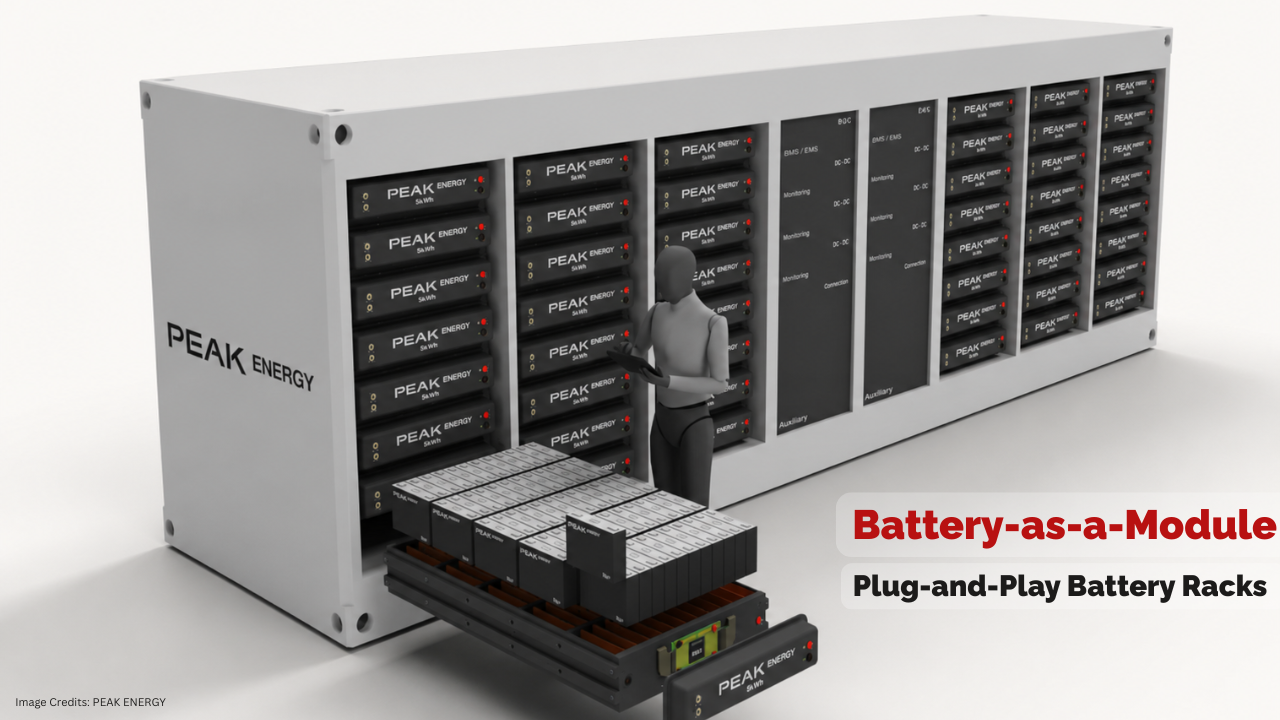
The BaaM concept is simple in principle but profound in operational implication. Instead of treating a BESS as a monolithic, fixed-capacity block, you design it from day one as a living, upgradeable platform — an assembly of standardised, individually addressable battery modules (typically rack-mounted) that can be inserted, removed, upgraded, or replaced without shutting down the entire system.
Think of it as applying the logic of a server farm to energy storage. In a data centre, a single failed hard drive does not bring down the cluster. A new server rack can be added under load. Capacity scales without a system-wide outage. The BaaM paradigm aims to deliver exactly this for stationary energy storage.

At its core, a BaaM ecosystem requires three things to work:
- Standardised physical form factors — rack-mounted modules with defined bus connector interfaces (analogous to 19″ server rack standards like IEC 60297)
- Intelligent, module-level BMS — a Battery Management System that treats each rack as an independent, self-aware node, capable of being isolated, balanced, and re-integrated dynamically
- An Energy Management System (EMS) that understands heterogeneity — software capable of orchestrating modules with different States of Health (SOH), different ages, and potentially even different chemistries on the same DC bus
The Technical Architecture: How Hot-Swap Actually Works
The mechanical side is mature. Rack-mounted LiFePO4 (LFP) battery modules in standardised enclosures — with slide rails for front-access insertion and extraction — are already deployed commercially. German operations and maintenance data shows an average physical module swap time of 17 minutes for a 50 kg unit, with system availability maintained at 99.98% through BMS-level fault isolation.
But the real engineering challenge is electrical. When you pull a degraded module out of a live DC bus and insert a new one, several potentially damaging phenomena can occur:

- Voltage mismatch: A new module at 100% SOC will have a different terminal voltage than surrounding modules at 70% SOC. Directly connecting them creates inrush current surges.
- SOC imbalance: The BMS must re-calibrate the new module’s state of charge relative to the string, or energy will be wasted in forced equalisation.
- Mixed SOH strings: New and old batteries have different internal resistances. The stronger new module can be forced to compensate for weaker aged ones, accelerating its wear.
The modern solutions to these challenges are:
Pre-Charge Circuits and Soft-Start Logic
Before a hot-swapped module is brought online, a pre-charge circuit ramps its connection current gradually, preventing voltage transients from propagating through the rest of the rack. This is standard practice in EV battery systems and is now being integrated into stationary BESS module connectors.

Module-Level DC-DC Converters
The most elegant solution for heterogeneous battery strings. DC-DC converters act as buffers at the string or module level, allowing new and old battery units to operate at their own optimal voltage and current profiles while feeding a unified DC bus to the main inverter. This is the critical enabler for truly mixing old and new modules — or even different chemistries — within the same system. The efficiency penalty is approximately 2% in standalone ESS configurations, but in DC-coupled solar-plus-storage systems, the same converters can improve round-trip efficiency by approximately 2% by eliminating low-voltage to medium-voltage transitions.

Distributed BMS with Cloud Telemetry
Advanced BMS architectures treat each module as an independent node on a CAN or RS485 network. Sensata’s LiBAL i-BMS15, for example, supports parallel pack operation and hot-swap functionality with ±3% SOC accuracy and ±2% SOH accuracy at the module level. When a module is swapped, the BMS re-discovers it, assigns it a unique address, and begins cell-level monitoring — voltage, temperature, and charge state — within seconds. Integration with cloud platforms allows digital twins of each module to be maintained continuously, enabling predictive maintenance, warranty tracking, and remote health assessment.

Fault Isolation Without System Shutdown
With module-level intelligence, a faulty rack can be electrically isolated by the BMS without interrupting the rest of the system’s operation. Array-level availability reaching 99.98% has been demonstrated, compared to much higher downtime in conventional monolithic designs that require full shutdown for any maintenance intervention.
AC Augmentation vs. DC Hot-Swap: Placing BaaM in the Landscape
To understand where BaaM sits, it helps to map it against the two conventional augmentation strategies:

AC augmentation’s added capacity can be installed without significant modifications to existing equipment, minimising disruption, but requires additional inverters, transformers, and potentially new grid connection approvals. DC augmentation leverages existing inverters but creates the “mismatch challenge” — connecting new and old batteries at the DC level can cause imbalances that accelerate wear on the newer units unless DC-DC converters are deployed.
BaaM is not a replacement for these strategies in every scenario — it is the operational paradigm for continuous, granular lifecycle management between major augmentation events, or the design philosophy that makes those events smaller and less disruptive when they do arrive.
Real-World Deployments: From Data Centres to Solar Farms
The BaaM approach is not theoretical. It is being deployed across multiple sectors:
Industrial UPS and Data Centres: Modular UPS battery racks with hot-swappable components are already standard practice in mission-critical data centres. Each module typically occupies just 2–3U of vertical space while delivering 5–10 kW, enabling vertical scalability with 3:1 space-saving ratios compared to legacy systems. The driving logic is identical to what BESS operators now need: zero-downtime maintenance in always-on environments.

Solar-Plus-Storage at Scale: At a 500 MW solar park in Dubai, deployment of stackable rack-mount LFP reduced storage expansion cycles from 3 weeks to 2 days, cut battery maintenance costs by 73% (primarily through modular swaps), and accelerated grid frequency response to 800 ms. A 200 MW solar farm in Xinjiang expanded battery capacity from a single 42U cabinet to 1 MWh in 4 hours using parallel rack additions.

TAE Power Solutions M-Series: This commercial modular BESS platform allows individual modules to be bypassed during failures for continued operation, then replaced when convenient. Critically, the system’s proprietary power management algorithms support heterogeneous battery modules of different chemistries and ages within the same system, dynamically balancing SOC, SOH, and temperature across every module in real time.

Motivo 800 VDC Racked Battery System: Designed with rail-based extraction for installer safety, hot-swap capability across all modules, and sub-second reading of hundreds of individual cell voltages with embedded thermal sensors. Custom PCBs handle charge balancing and protocol translation between the rack system and individual modules.

The Software Layer: BaaM Needs a Digital Brain
Hardware modularity without software intelligence is just a shelving unit. The BaaM ecosystem’s true value is unlocked by three layers of software:
Module-Level BMS: Every module requires its own embedded intelligence — cell voltage monitoring, temperature sensing, SOC/SOH estimation, fault detection, and communication protocols (CAN, RS485, Modbus). When a module is hot-swapped, the BMS must autonomously discover, characterise, and integrate the new unit without human intervention.
Rack/System-Level EMS: The EMS coordinates dispatch across a heterogeneous module population. It manages which modules charge or discharge first based on SOH, avoids over-cycling weaker units, and optimises round-trip efficiency by routing power through the healthiest modules during peak demand windows.
Cloud-Connected Digital Twins: Each physical module should have a corresponding digital twin — a continuously updated model tracking its degradation history, thermal exposure, and remaining useful life. This enables:
- Predictive module replacement before failure, not after
- Warranty lifecycle management at the module level
- Second-life routing — retired modules from C&I BESS automatically flagged for repurposing as backup power, with 40% higher residual value recovery compared to non-tracked modules

LF Energy Battery Data Alliance launched the Battery Data Format (BDF) in January 2026 — an open, machine-readable standard for sharing battery data across vendors and platforms, enabling consistent interoperability for exactly this kind of module-level digital ecosystem.
The Standardisation Challenge: The Missing “USB Port” for BESS
The single biggest barrier to a true BaaM ecosystem is the absence of a universal mechanical and electrical interface standard for battery modules. Today, every manufacturer uses proprietary connector geometries, bus bar specifications, and communication protocols. A rack from Vendor A cannot be dropped into a system from Vendor B.
This is not a new problem — the IT industry solved it through standardisation (19″ rack, SATA, PCIe). The energy storage industry is now at a comparable inflection point.

Current progress includes:
- IEC 60297-3 for rack enclosure standardisation (widely adopted in IT, increasingly referenced in BESS)
- IEC TS 62786-3:2023 for distributed BESS grid interconnection requirements, covering communication, active/reactive power response, and interface protection
- IEC 62933-5-2:2025 (Edition 2, published December 2025) covering safety requirements for the entire lifecycle of grid-connected electrochemical BESS — a critical framework for standardising safe hot-swap procedures
- SunSpec Modbus, IEEE 1815.2, and IEEE 2030.5 as protocol-agnostic communication frameworks being mapped to IEC 61850-7-420 data models for BESS interoperability
The emergence of open communication frameworks and open-source standards (like BDF) signals that the industry is moving, even if slowly, toward the interoperability layer that BaaM ecosystems require.
Why This Matters for India’s C&I Market Right Now
India’s energy storage market is experiencing structural acceleration. C&I energy storage installations are forecast to grow tenfold to reach 31 GWh by 2032, with industrial facilities accounting for over half of all ESS deployments and data centres and critical infrastructure leading the fastest growth. India’s installed BESS capacity was forecast to jump nearly tenfold in 2026 alone, from 507 MWh in 2025 to approximately 5 GWh.

This growth creates an acute need for the BaaM paradigm — for three India-specific reasons:
1. Operational continuity in C&I applications is non-negotiable. A pharmaceutical plant, a data centre, or a manufacturing facility running on BESS-backed open access power cannot afford a 3-day shutdown for augmentation work. The ability to swap a degraded module during a scheduled maintenance window — with zero impact on energy supply — is a fundamental operational requirement.
2. The augmentation problem arrives faster in India’s thermal environment. Battery degradation is strongly linked to thermal stress. In Indian C&I deployments operating in high ambient temperature conditions, capacity fade timelines are compressed. Projects may see their first augmentation need as early as Year 5–6. Designing for module-level replaceability from the start is not optional — it’s lifecycle planning.

3. LFP dominates, and LFP has unique mixing constraints. Unlike NMC or NCA chemistries with sloping voltage-SOC curves that facilitate balancing between old and new cells, LFP’s flat voltage profile means new and old LFP batteries cannot be naively mixed on the same DC bus. This makes the DC-DC converter architecture — the key enabler of true hot-swap in LFP systems — especially important for India’s LFP-dominant BESS market.
India’s BESS market already has 29.6 GWh in the project pipeline with players like Tata Power, Adani, and JSW Energy leading deployment, while the market size is projected to grow from USD 2.05 billion in 2026. The next generation of these projects, designed with BaaM architecture, will have structurally lower lifecycle costs and higher bankability.

The Business Model Angle: From Asset to Service
The BaaM paradigm enables a shift in how energy storage is commercially structured. ABB’s May 2025 launch of BESS-as-a-Service — a zero-CapEx model where ABB manages all hardware, software, and lifecycle support for a quarterly fee — is a direct commercial expression of the modular philosophy. When modules are standardised and hot-swappable, the service provider can rotate hardware across sites, upgrade modules as technology improves (higher energy density cells, newer chemistries), and maintain performance guarantees without requiring the customer to manage physical assets.
This is the BaaM commercial endpoint: a subscription model for energy storage capacity, where the underlying module population is continuously optimised by the service provider, and the customer simply consumes kilowatt-hours — much like cloud computing eliminates the need to own servers.

Designing for BaaM: What to Get Right from Day One
For developers, asset managers, and C&I energy buyers specifying BESS systems today, the BaaM future requires forward-looking design decisions:
- Specify modular rack architecture with front-access or rail-extraction capability, even at slight premium to monolithic enclosure costs
- Require module-level BMS with CAN/RS485 communication and unique addressing — not just a string-level BMS
- Reserve DC bus capacity headroom for future module additions without inverter oversizing penalties
- Negotiate augmentation rights and module compatibility guarantees in OEM supply agreements — the contractual right to add third-party modules or upgrade chemistries without voiding warranties
- Integrate cloud telemetry from commissioning — digital twins must begin accumulating module history from day one, not from the first fault event
- Adopt open communication protocols (SunSpec, IEC 61850-7-420) to avoid vendor lock-in at the EMS layer

The Road Ahead
Battery-as-a-Module is not a distant vision — the building blocks exist today. The rack form factors are standardised. The BMS intelligence is proven. The DC-DC converter architectures are deployed commercially. The cloud telemetry frameworks are available. What remains is the industry-wide commitment to open, interoperable module interfaces that turn individual product innovations into a true ecosystem.

The BESS industry is at the same inflection point the computing industry reached in the 1980s, when proprietary hardware gave way to standardised components and the PC ecosystem exploded. When a project developer in Mumbai can specify a rack from Manufacturer A, fill it with modules from Manufacturer B, manage it with software from Manufacturer C, and augment it five years later with chemistry from Manufacturer D — all without system downtime — the “Battery-as-a-Module” era will have arrived.
No Responses