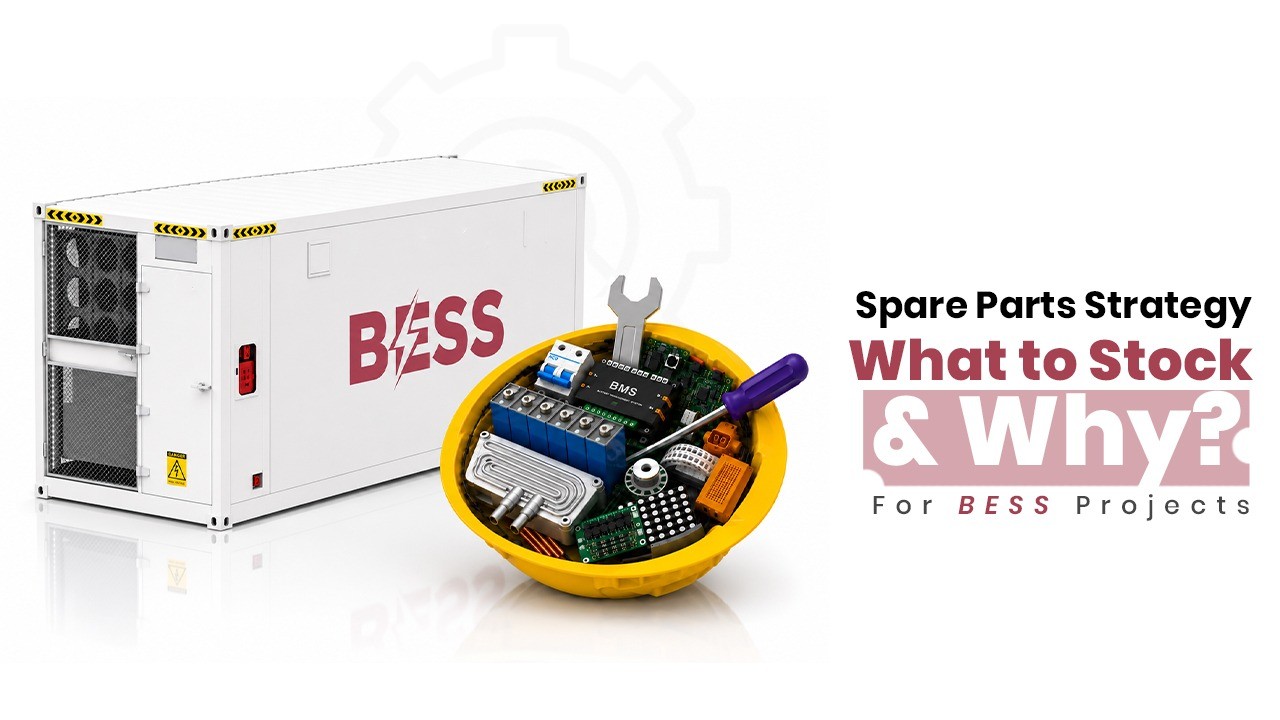
Battery Energy Storage Systems (BESS) are being deployed across India’s C&I and utility landscape at a pace that has outstripped the maturity of after-sales supply chains supporting them. Unlike a solar PV plant, where a failed module simply reduces yield, a BESS failure in a critical subsystem — a contactor, a DC fuse, a cooling fan, or a communication card — can trip an entire rack, container, or in the worst case, the whole system offline, directly hitting revenue from energy arbitrage, peak shaving, or ancillary services contracts. A deliberate spare parts strategy is therefore not a back-office logistics decision; it is a core determinant of project bankability and IRR.
Empirical BESS Failure Dynamics and Bathtub Curve Profiles
An optimized spare parts strategy must be built on empirical failure data rather than idealized, manufacturer-declared failure rates. While grid-scale BESS safety-related failures declined by approximately 97% between 2018 and 2023 due to improved manufacturing and design standards, operational telemetry from 2025 demonstrates that roughly 19% of grid-scale battery storage installations still experience recurring hardware failures and operational disruptions annually. This means approximately one in five storage projects struggles with performance issues that directly erode revenue targets.

The ABC-VED Inventory Classification Framework
To construct an economically optimized spare parts strategy, developers must utilize a multi-dimensional inventory classification system. Relying solely on consumption value or component criticality in isolation leads to either excessive capital lock-up or prolonged, high-cost outages. Merging ABC analysis—which categorizes spares based on their cumulative inventory value—with VED (Vital, Essential, Desirable) analysis—which rates components by their operational impact—provides a structured framework for stocking decisions.


By mapping the entire BESS bill of materials into a combined ABC-VED matrix, asset managers can determine the most cost-effective stocking locations, replenishment cycles, and supply chain strategies.

The Core Principle: Not Everything Should Be Stocked
It is not economically feasible to stock a spare for every conceivable failure mode in a BESS plant. Instead, asset owners and O&M providers should run a structured cost-benefit exercise for each candidate part, weighing the cost of holding stock against the cost of downtime if the part fails and is unavailable. The industry-standard decision parameters for setting stocking levels are:
- Frequency of failure — how often does the part fail historically or per manufacturer MTBF data
- Impact of failure — does it cause a full outage, a derated capacity, or merely a loss of visibility (e.g., a SCADA sensor)
- Cost of the spare part relative to the cost of the resulting downtime
- Replenishment/lead time — parts with long procurement cycles deserve buffer stock even if failure frequency is low
- Degradation over time while sitting in inventory (relevant for electrolytic capacitors, batteries, seals)
- Possibility of consignment stock held by the manufacturer instead of the owner
- Equipment reliability and manufacturer track record
- Management/visibility risk — for instance, a failed SCADA or communication component may not cause a power loss but blinds the operator to a future fault, which is itself a risk worth mitigating
A useful illustrative rule from adjacent solar O&M practice: a part with an expected failure rate of once a year or more, where downtime cost exceeds the part price, should always be held in stock regardless of unit cost. BESS operators are adapting similar logic, calibrated to the much higher revenue-at-risk per hour of BESS downtime versus solar.
What to Stock: A Component-by-Component Breakdown

Electrical protection components deserve particular emphasis for Indian BESS deployments: DC-side fuses and contactors operating at 1,000-1,500V system voltages must be electrochemically and electrically matched to OEM specifications, since non-OEM connectors and mismatched voltage-ripple components have been linked to accelerated capacity degradation and cascading failures that even a well-functioning BMS cannot fully arrest. Sourcing generic or non-certified replacements to save cost on these parts is a common but costly false economy.

Sizing the Spare Module Buffer
For battery racks and modules specifically, the practice of holding a “spare module buffer” — extra modules sized as a small percentage of total installed capacity — is emerging as a way to avoid full-string outages while warranty replacement or repair is processed. Effective spares management for battery modules is less about stocking more units and more about knowing the exact health, compatibility, and warranty status of every module in inventory and in the field, since modules from different production batches can have subtly different state-of-health characteristics that affect string balance if swapped in carelessly. This underscores that spares strategy for BESS cannot be purely quantitative; it also requires a digital record of part provenance, firmware version, and warranty status.

Determining “how much” to stock, not just “what,” requires weighing several parameters together: failure frequency, failure impact, part cost, degradation behavior over time, availability of consignment stock with the manufacturer, underlying equipment reliability, replenishment lead time, and the management risk of an undetected fault. Practical inventory management for spares generally follows min/max stocking levels and reorder points tracked through a computerized maintenance management system (CMMS), supported by cycle counts to keep physical and recorded stock aligned. Rather than “stocking more,” effective spares management is about knowing the exact health, compatibility, and warranty status of every module held in reserve — over-provisioning ties up capital in items that may never be used or that degrade while in storage.

Procurement lead times are a critical variable in right-sizing inventory, and they shift with market conditions. Illustrative lead times reported for BESS-critical components include roughly eight to twelve weeks for battery modules from major Asian suppliers (longer for domestically sourced cells subject to local content requirements), six to twelve weeks for PCS units from major power electronics manufacturers, twelve to twenty-four weeks for transformers from established domestic suppliers, eight to sixteen weeks for proprietary control boards, and four to eight weeks for fire suppression equipment. Because these lead times fluctuate with semiconductor supply and geopolitical conditions, an annual review of the stocking plan against current lead times is recommended.
Supplier Agreements and Ownership Models
Spare parts strategy is inseparable from contract structure. In utility-scale renewable O&M practice, spare parts and consumables are typically distinguished contractually, with the O&M provider responsible for maintaining consumables on hand and following a jointly-agreed spare parts list. Contracts commonly split responsibility into “included” spare parts (covered within the O&M fee) and “excluded” spare parts (billed separately to the asset owner), often with a negotiated financial cap on included items — this balances cost certainty for the owner against the provider’s risk appetite. Ownership of spares generally rests with the asset owner from the point of delivery or placement into stock, and clear insurance responsibility (on-site spares insured by the owner, off-site spares insured by the provider) is a recommended best practice to avoid coverage gaps.

For new projects, best practice is for the initial two years of spares (post commercial operation date) to be procured by the asset owner or EPC contractor on the owner’s behalf, based on a list jointly developed with the O&M provider, who may recommend additional spares needed to meet contractual availability guarantees. Manufacturer after-sales models have matured considerably, with options spanning long-term support contracts (ten to twenty years, bundling scheduled maintenance with parts supply guarantees), performance-linked contracts tied to capacity or state-of-health guarantees, pay-per-use servicing, and EPC-integrated long-term maintenance where the construction contractor also owns the maintenance relationship. Major manufacturer service programs — including branded fleet-monitoring and dispatch-optimization platforms tied to after-sales support — are becoming an industry standard reference point for evaluating a supplier’s spares maturity. When assessing a BESS manufacturer, buyers are increasingly advised to explicitly interrogate how spare parts are stocked, where they are physically located, and what lead times apply, since these factors directly determine real-world uptime rather than nameplate specifications.

A key risk to hedge against is manufacturer discontinuation or business model shifts that can leave an operator without a parts pipeline for legacy equipment — a scenario observed in shifts within the sodium-based battery supply chain — which argues for multi-vendor sourcing strategies and verified compatible-part options wherever the underlying technology allows it.
Where and How to Store Spares
Storage location decisions balance three factors: proximity to the plant for fast dispatch, environmental protection from humidity, temperature swings, and dust, and physical security against theft or damage. Batteries and power electronics held in inventory are also subject to degradation over time, so storage protocols should specify periodic state-of-charge maintenance for spare battery modules and environmental monitoring of the storage facility itself. For India, this has practical implications: spares stored in un-conditioned warehouses in high-humidity coastal regions or dust-heavy industrial belts should follow stricter environmental controls than a like-for-like stock held in a temperate climate.
Domestic Sparing Economics and Basic Customs Duties: The financial viability of local spare parts warehousing is heavily impacted by Indias tariff structure. Imported, finished containerized BESS assemblies attract a Basic Customs Duty (BCD) of 20% to 25%. For a 10 MWh project with an equipment valuation of INR 45–55 Crore, this customs duty translates into an immediate capital expenditure penalty of INR 9–14 Crore.

Conversely, importing raw LFP prismatic cells—which are priced at multi-year lows of USD 65–80 per kWh (CIF India)—attracts significantly lower duty thresholds. This tax disparity has driven a major shift toward domestic integration. By importing raw cells and locally fabricating modules, racks, and thermal management systems, developers can eliminate finished-goods import duties, bypass ocean freight delays of 5 to 8 weeks, and drastically reduce the lead times of replacement components.
Global Procurement Realities and Lifecycle Sparing Paradigms
Constructing a comprehensive spare parts list is only effective if operators can navigate a constrained global logistics landscape. The procurement of high-voltage electrical equipment remains highly restricted. Standard medium-voltage switchgear lead times range from 24 to 32 weeks, while utility-scale power transformers (above 20 MVA) routinely face lead times exceeding 12 months in Europe and North America, and up to 3 to 7 years for large-scale transmission units. These bottlenecks are driven by soaring global demand from data centers, renewable energy projects, and aging grid infrastructure upgrades.
To mitigate these supply chain risks, developers must align their spare parts strategy with the project’s physical layout, geographical location, and contract structure.

Sparing Paradigms: On-Site Storage, VMI, and Regional Sparing Pools
Asset managers generally evaluate three primary sparing paradigms to balance response speed against working capital limits:
- On-Site Dedicated Stocking: This model is essential for low-cost, high-criticality components (Class III and Class VI spares). Maintaining fuses, sensors, control cards, and coolant on-site ensures the local operations and maintenance (O&M) team can resolve minor failures immediately. However, dedicated on-site storage of high-value capital assets (Class I) is economically inefficient and can expose components to environmental damage if not stored in climate-controlled warehouses.
- Vendor-Managed Inventory (VMI) and Long-Term Service Agreements (LTSAs): Under a VMI or LTSA structure, the BESS OEM or system integrator assumes physical and financial ownership of the spare parts pipeline. The vendor maintains regional parts hubs, guarantees specific component availability, and manages hardware revision control. This model transfers supply chain risk to the OEM and is highly effective for proprietary controls and inverter components. However, contract negotiations must explicitly define when downtime begins (e.g., from remote fault detection vs. formal written notification) to prevent delayed vendor dispatch from eroding project revenues.

- Shared Regional Sparing Pools: For long-lead, high-capital equipment like grid-connection transformers and high-voltage switchgear, developers operating multiple assets in the same region can establish joint sparing pools. By sharing the cost of a single, centrally warehoused spare transformer or switchgear lineup across multiple adjacent projects, developers can achieve a 70% reduction in individual capital lock-up while maintaining a rapid physical response to catastrophic failures.
Regional Regulatory Compliance: The Indian Sparing Landscape
Developing utility-scale BESS assets in highly regulated emerging markets requires strict alignment with localized technical and commercial standards. India, which is rapidly expanding its storage capacity under the national Viability Gap Funding (VGF) scheme, represents a key example of how regional policies reshape spare parts strategies.
The VGF framework, which targets the commissioning of 4,000 MWh of BESS projects, provides capital cost subsidies of up to 40%. This support aims to compress levelized cost of storage (LCOS) tariffs down to INR 5.50–6.60 per kWh.

In exchange for this financial support, projects must adhere to strict operational availability SLAs, often exceeding 99%, which can only be achieved through localized spare parts hubs.
Domestic Sparing Economics and Basic Customs Duties
The financial viability of local spare parts warehousing is heavily impacted by India’s tariff structure47. Imported, finished containerized BESS assemblies attract a Basic Customs Duty (BCD) of 20% to 25%. For a 10 MWh project with an equipment valuation of INR 45–55 Crore, this customs duty translates into an immediate capital expenditure penalty of INR 9–14 Crore.
Conversely, importing raw LFP prismatic cells—which are priced at multi-year lows of USD 65–80 per kWh (CIF India)—attracts significantly lower duty thresholds.

This tax disparity has driven a major shift toward domestic integration. By importing raw cells and locally fabricating modules, racks, and thermal management systems, developers can eliminate finished-goods import duties, bypass ocean freight delays of 5 to 8 weeks, and drastically reduce the lead times of replacement components.
Indian BIS Standards and Safety Regulations
The Ministry of New and Renewable Energy (MNRE), in coordination with the Bureau of Indian Standards (BIS), enforces strict technical compliance regimes. Under the Solar Systems, Devices, and Components Goods Order, BESS installations must conform to mandatory standards that govern cell-level safety, battery management systems, and grid integration.
These BIS frameworks mandate that battery chargers be chemically matched to cell chemistry, and enforce strict, independent environmental and ventilation testing under Central Electricity Authority (CEA) guidelines.

Furthermore, tender regulations from agencies like SECI require bidders to submit legally binding guarantees securing service and spare parts availability for a minimum of 10 to 15 years post-commissioning. These long-term compliance mandates prevent operators from relying on low-cost, uncertified aftermarket parts. This reinforces the operational value of establishing partnerships with domestic developers (such as Amara Raja Group, Exide Industries Limited, and Su-vastika Systems Private Limited) to ensure rapid access to BIS-compliant components.

The Bottom Line
A spare parts strategy is really a risk allocation exercise dressed up as a procurement task. The components that deserve dedicated capital are the ones combining high failure consequence with long, single-source lead times — PCS power modules, BMS boards, and critical protection/communications electronics — not necessarily the components that fail most often. Everything else can be handled more cheaply through pooling, vendor agreements, or simple bulk stocking of consumables. Getting this balance right, and revisiting it as the fleet and the technology mature, is one of the highest-leverage things an asset owner can do to protect BESS revenue and reliability.
No Responses