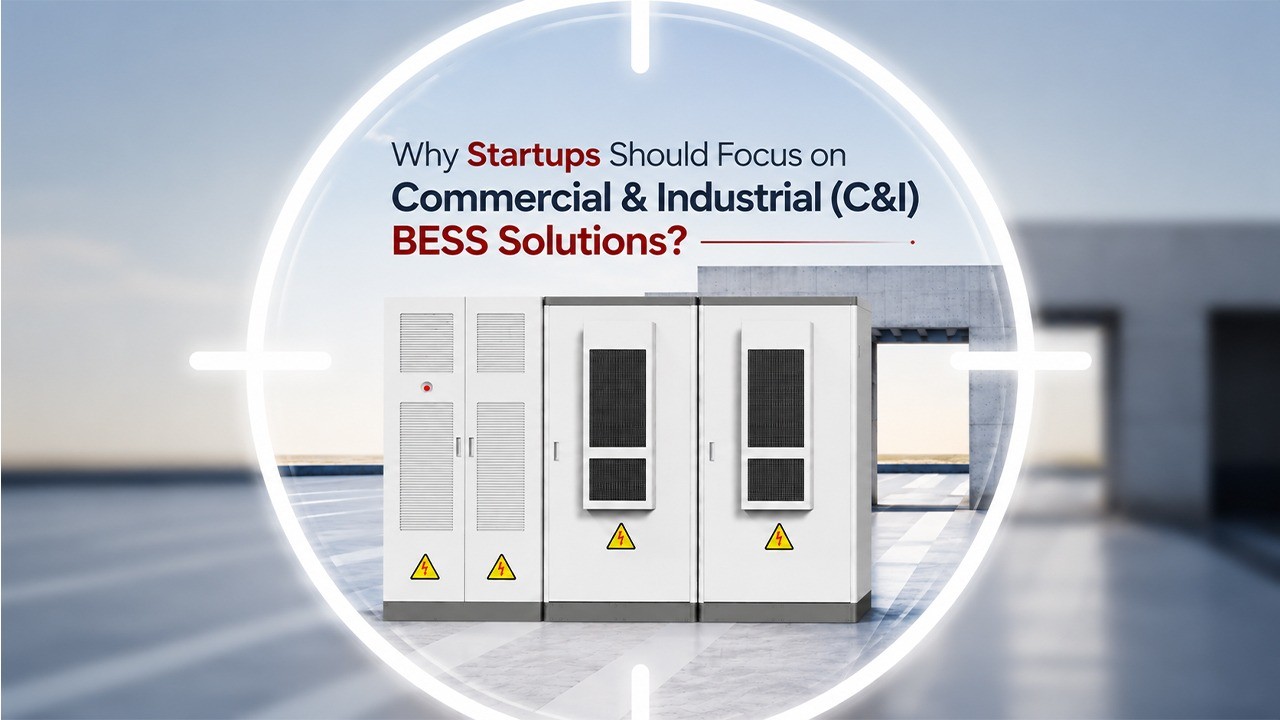
India’s energy storage sector is at an inflection point, and the segment generating the most excitement for new entrants is not the mega-scale grid tender — it is the Commercial & Industrial (C&I) behind-the-meter market. While utility-scale Battery Energy Storage Systems (BESS) dominate headlines and capital deployment, C&I storage offers startups a faster, cheaper, and more defensible path to revenue and scale.
The Market Opportunity Is Large and Accelerating
India’s overall BESS market is projected to grow from approximately $1.5 billion in 2025 to $7.5–8.6 billion by 2030-2031, at a CAGR of roughly 33 percent. Within this, the C&I segment is the fastest-growing sub-segment: a joint IESA-CES report projects India’s C&I energy storage installations to grow more than tenfold, reaching up to 31 GWh by 2032, driven by corporate decarbonization, rising grid tariffs, and demand for energy resilience. Globally, the C&I BESS market is forecast by Frost & Sullivan to more than triple from $3.18 billion in 2023 to $10.88 billion by 2030, and reach $21.64 billion by 2035, at a 20.1 percent CAGR in capacity terms.

Industry estimates place C&I’s direct share of India’s installed BESS capacity at 15-18 percent by 2030 out of an expected 40 GWh total, but this understates momentum — C&I uptake is rising at roughly 36.2 percent annually, the fastest of any end-user category, compared to 70 percent utility-scale share today. Industrial facilities alone are expected to account for more than half of all C&I energy storage installations, with data centers, hospitals, metro systems, and airports showing the fastest growth.
Why C&I Is More Startup-Friendly Than Utility-Scale BESS
The utility-scale and FTM segments of India’s BESS market are structurally difficult for startups to enter. Between 2022 and May 2025, India auctioned approximately 12.8 GWh of BESS capacity for hybrid and standalone applications, yet only about 219 MWh was actually operational — a gap driven by aggressive underbidding, delayed power purchase agreement (PPA) signings, and financing costs elevated by up to 400 basis points due to perceived project risk. Bid tariffs in utility auctions fell 41.3% between the GUVNL Phase 3 tender in March 2024 and the Rajasthan 500 MW auction in November 2024, a race-to-the-bottom dynamic that squeezes margins and rewards only the largest, best-capitalized players such as TATA Power , Adani Energy Solutions Ltd. , and Reliance Energy , who together with a handful of peers control roughly 45% of market share.

C&I projects sidestep much of this. Contracts are signed directly with private industrial or commercial off-takers rather than discoms, PPA negotiation cycles are shorter, ticket sizes are smaller (typically 1-10 MW rather than 100+ MW), and payback is driven by measurable, immediate operational savings rather than long-tenor 25-year regulated tariffs. A representative 5 MW manufacturing facility deploying a 2-3 MWh BESS incurs total capex of roughly ₹6-9 crore and generates annual savings of ₹1.2-1.6 crore through time-of-day (ToD) arbitrage and demand-charge management, delivering a simple payback of around five years. These economics are legible to a corporate CFO in a way that utility-scale merchant risk is not, making the C&I sales cycle shorter and less dependent on sovereign-scale balance sheets.
Better Unit Economics Than Utility-Scale Storage
The single most compelling reason for startups to prioritize C&I is economics. C&I behind-the-meter projects deliver IRRs of 14-18 percent, compared to 10-12 percent for utility-scale storage, because industrial customers are willing to pay directly for demand charge reduction, time-of-day arbitrage, and resilience rather than depending on regulated tariff structures. States with high Time-of-Day (TOD) tariff differentials — Maharashtra, Tamil Nadu, and Karnataka — represent the immediate addressable market, with the segment expected to grow at approximately 50 percent CAGR through 2030.

A recent industry analysis found a 120 kW C&I battery project achieved a turnkey capex of roughly £300,000/MW, about 35 percent below a comparable grid-scale benchmark, reinforcing that C&I batteries can outcompete utility-scale storage on both cost and speed. This cost advantage stems from smaller, standardized system sizes, shorter interconnection queues, and the absence of complex transmission-level engineering.

Faster Deployment Means Faster Revenue and Lower Execution Risk
Unlike multi-hundred-MWh utility tenders that require years of land acquisition, grid studies, and regulatory clearance, a 500 kW-1 MWh C&I system can be commissioned in weeks rather than years, dramatically shortening the time from capital deployment to cash flow. This speed advantage compounds through modular, standardized “plug-and-play” designs that eliminate much of the labor-intensive on-site assembly that plagues container-scale BESS projects; industry data shows installation, engineering, and grid connection can account for up to $50/kWh of total installed cost, and halving deployment time can cut soft costs by 20-40 percent. For a capital-constrained startup, this translates directly into a shorter runway-to-revenue cycle and lower construction-phase risk relative to grid-scale peers.

Lower Barriers to Entry for Capital-Constrained Startups
Utility-scale BESS requires bidding into multi-year SECI or state DISCOM tenders, competing against conglomerates such as Adani, Reliance, Tata Power, and JSW Energy, which together control roughly 81 percent of India’s contracted pipeline. This concentration leaves little room for undercapitalized new entrants. C&I, by contrast, is fragmented and underserved: pure-play developers like Amplus Solar , Cleantech Solar , Fourth Partner Energy , and Vibrant Energy are scaling but the market remains open for startups offering differentiated, application-specific products rather than pure commodity hardware.

A practical business model already being tested in the market pairs BESS EPC and trading with local assembly: importing cells at a 5 percent customs duty for domestic assembly (versus higher duties on complete containers) can generate roughly 15 percent cost savings, with landed costs around $134/kWh for a complete 5 MWh container versus roughly $84/kWh for a DC-only block. This “import-assemble-integrate” pathway lets startups enter the value chain without the prohibitive capex of full-scale cell manufacturing, which industry analysis flags as high-CAPEX and generally unviable for small players.
C&I Solves Real, Underserved Pain Points
C&I customers in India face concrete problems that create willingness to pay: steep Time-of-Day penalties and Maximum Demand charges from DISCOMs, unreliable grid supply in Tier 2/3 industrial parks and SEZs, and heavy reliance on costly diesel generators. BESS directly addresses peak shaving, diesel genset optimization, renewable self-consumption when paired with rooftop solar, and power-factor correction — use cases with immediate, quantifiable ROI rather than dependence on evolving ancillary-services markets. Textile, pharma, food processing, packaging, steel, and data center operators each have distinct load profiles, meaning value is created through tailored engineering rather than one-size-fits-all boxes — an opportunity for startups that can productize configurable, use-case-specific systems.

For India’s roughly 42-45 percent of total electricity consumption attributable to the C&I sector, BESS offers cost reduction, reliability, and renewable maximization, yet adoption still lags due to high upfront capex, immature financing, and limited awareness — gaps a nimble startup can fill with financing innovation (Storage-as-a-Service, Battery-as-a-Service) and education-led sales motions.
Policy Tailwinds Are Building, Though Gaps Remain
Government support has so far concentrated on utility-scale storage — the INR 3,760 crore Viability Gap Funding scheme and the 50 GWh Advanced Chemistry Cell PLI program are both utility- and manufacturing-oriented — but state-level mechanisms increasingly favor C&I. Rajasthan’s Green Open Access rules mandate 5 percent BESS attachment and allow up to 200 percent of contract demand, the Central Electricity Authority mandates minimum 10 percent Energy Storage System co-located with solar, rising to 40 percent by 2030, and Maharashtra’s TOD policy — with high tariffs from 5 PM to midnight — makes BESS essential for peak load shifting. These distributed, state-driven rules create a regulatory tailwind more accessible to nimble startups than mega-tenders dominated by conglomerates.

India’s storage policy architecture, while largely built for utility-scale deployment, creates favorable spillover effects for C&I. The Ministry of Power’s Viability Gap Funding (VGF) scheme underwrites up to 40% of capex for standalone BESS projects, and by late 2024 had sanctioned 1,200 MWh across projects worth INR 4,800 crore, catalyzing USD 580 million in private investment. The Production-Linked Incentive (PLI) program for Advanced Chemistry Cells, with an outlay of roughly ₹181 billion, is building domestic cell manufacturing capacity that startups can eventually source from at lower landed costs, narrowing the import-cost differential from 22% in 2023 toward a projected 8% by 2027.

State-level innovation is arguably more relevant to C&I founders than central schemes: Gujarat, Karnataka, Tamil Nadu, and Rajasthan have introduced cost-reflective banking and settlement policies plus transmission-charge waivers that materially improve the economics of distributed, behind-the-meter storage tied to open-access renewable procurement. Maharashtra, Karnataka, and Gujarat’s steep peak-versus-off-peak tariff differentials are direct demand drivers for arbitrage-focused C&I BESS deployments.
Business Model Innovation: BESS-as-a-Service
One of the clearest openings for startups is business-model innovation rather than hardware innovation. Traditional BESS ownership requires significant upfront capital and in-house technical expertise that deters many C&I customers, particularly SMEs and mid-tier industrial units. BESS-as-a-Service (BaaS) models — where a startup or integrator owns and operates the asset while the customer pays a predictable operating expense, often with day-one positive ROI — are emerging specifically in the C&I and open-access segment, with the TERI – The Energy and Resources Institute -BSES model cited as an early Indian example.

Financing structures suited to C&I include operational leasing (developer retains ownership, customer pays periodic fees), financial leasing (customer eventually owns the asset), and revenue stacking that combines demand-charge management with arbitrage and, eventually, ancillary services to shorten payback periods. Industry commentary projects that by 2028-29, storage-as-a-service and flexible financing models will meaningfully expand adoption across SMEs and mid-tier industries — precisely the customer segment better served by agile startups than by conglomerate-scale developers focused on gigawatt tenders.
Financing Innovation Is the Next Frontier — and a Startup Opening
Financing remains the biggest structural gap in C&I BESS, and this is precisely where startups can differentiate. Unlike rooftop solar, which matured through RESCO and PPA/OPEX models that removed upfront capex barriers for customers, battery storage financing is still nascent: lenders view it as a new asset class with limited operating history, resulting in cautious underwriting and higher rates. Emerging Storage-as-a-Service and Battery-as-a-Service models are beginning to close this gap, and startups that combine hardware integration with innovative financing and digital Energy Management System (EMS) platforms — AI/ML-driven dispatch optimization, predictive maintenance, and digital twins — can capture disproportionate value as India’s storage-linked tenders and Green Open Access rules mature.

Execution Discipline Determines Winners
Success in C&I BESS is not simply a matter of sourcing cheaper cells. Industry practitioners emphasize that container BESS and C&I systems demand rigorous attention to cell quality and consistency, thermal management, EMS/BMS logic tuning, fire safety engineering, and integration with legacy site infrastructure — factors that determine whether a system performs reliably for its 15-year design life. Auxiliary power consumption, active/reactive power management, and civil/I&C processes at site level are frequently underestimated technical risks that erode commercial viability if not engineered correctly. Panels at recent industry webinars stressed that every C&I deployment is unique — system design must reflect specific customer load profiles rather than standardized configurations — reinforcing that engineering depth, not just capex access, is the true moat for BESS startups entering this space.

The Bottom Line for New Entrants
C&I BESS offers startups a rare combination in energy infrastructure: a large and rapidly growing addressable market, superior project-level returns, shorter sales and deployment cycles, and lower capital intensity than utility-scale alternatives, all against a backdrop of underserved industrial demand and improving policy support. Startups that combine disciplined system engineering with innovative financing and digital EMS capabilities are best positioned to convert this structural opportunity into durable, scalable businesses as India’s storage ecosystem matures from pilot projects toward mainstream commercial deployment.

No Responses